Quick Navigation
The First Approach to Koh Nang Yuan Thailand
When you leave Koh Tao heading toward Koh Nang Yuan Thailand, nothing about the first few minutes suggests that you’re about to arrive somewhere fundamentally different. The boat ride is short enough that it doesn’t feel like a transition between destinations, just a continuation of the same environment—open water, steady movement, familiar colors stretching in every direction.
At first, everything looks predictable.
The sea holds that deep, even blue that dominates most of the Gulf of Thailand. The surface reflects light in a way you’ve already seen dozens of times before. There’s no signal, no visual clue that something unusual is ahead. If anything, it feels like you’re heading toward just another small island—one of many that share similar shapes, similar vegetation, similar coastlines.
Then something begins to shift, and it happens so gradually that you don’t immediately register it.
The blue starts to soften. Not dramatically, but enough that your eye catches the difference. You look down, and instead of seeing reflections, you begin to see through the water. The seabed appears in fragments at first—patches of lighter sand, darker shapes that suggest coral, subtle variations that reveal changes in depth.
The clarity keeps increasing.
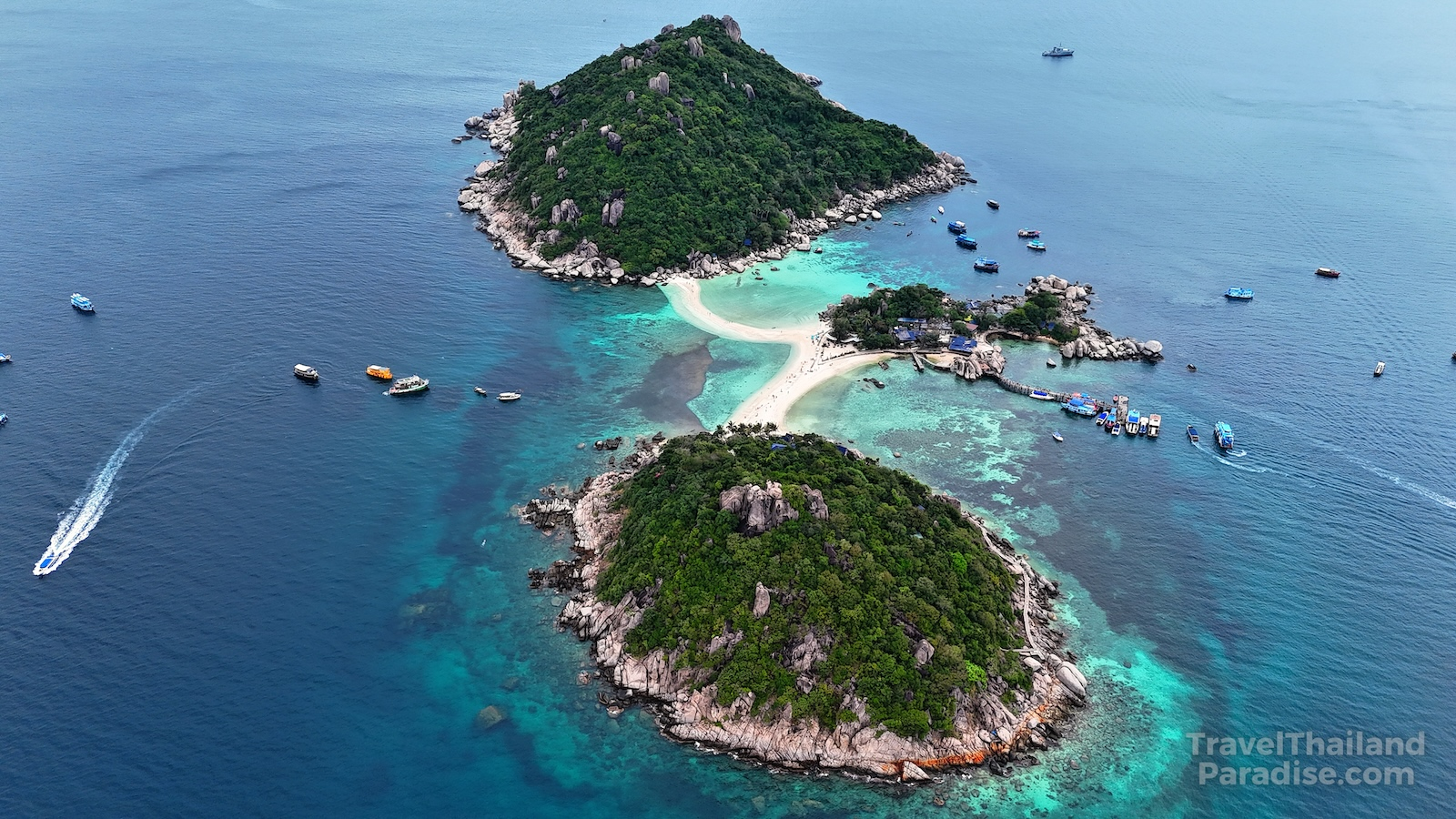
This cinematic 4K drone video takes you above one of Thailand’s most unique islands, where three small islands are connected by a stunning white sandbar surrounded by crystal-clear turquoise water.

At a certain point, you realize you’re no longer guessing what’s beneath the surface—you’re observing it directly. The water stops acting like a barrier and starts behaving like glass. Light passes through it cleanly, illuminating everything below in a way that feels almost artificial.
That’s when your attention shifts completely. Not forward yet—but downward.
And then, almost at the same time, the islands enter your peripheral vision.
Three small landmasses, rising quietly from the water. Nothing about them seems remarkable at first. They don’t tower dramatically. They don’t dominate the horizon. They just sit there, covered in dense green, appearing almost understated.
But as the boat continues forward, something about them stops making sense.
The space between the islands disappears.
At first, you assume it’s just perspective. Distance compressing the view. But the closer you get, the clearer it becomes that it’s not an illusion. A narrow strip of white sand connects them, stretching across the water in a way that feels too clean, too precise.
Your brain hesitates for a moment. Because this isn’t how islands are supposed to look.
They’re supposed to be separate. Formed randomly. Shaped by forces that don’t care about symmetry or balance. But Koh Nang Yuan Thailand looks like it was arranged—like someone intentionally placed each piece exactly where it is.
That’s the moment the experience shifts.
Not into excitement. Not into amazement.
But into curiosity.
When the boat slows and you step onto the sandbar, the feeling deepens. Water stretches out on both sides, shallow enough to reveal everything beneath it. The sand feels firm under your feet, stable, almost anchored.
There’s no dramatic realization. Just a quiet pause.
And the understanding that this place operates differently.
Walking the Sandbar: Where Koh Nang Yuan Thailand Feels Most Unreal
Once you step onto the sandbar at Koh Nang Yuan Thailand, the experience shifts from observation to something much more physical. Up until this point, everything has been about perspective—how the island looks from the boat, how the water changes color, how the structure doesn’t quite make sense from a distance.
See what it’s actually like to walk around Koh Nang Yuan. Watch this complete 4K walking tour before continuing. It gives you a real feel for the atmosphere, beaches, and the famous sandbar connecting the islands.

But standing on the sandbar forces you into the middle of it, and that’s when the difference becomes impossible to ignore. At first, it feels simple.
You’re standing on sand, surrounded by water. Nothing unusual about that in Thailand. But within a few steps, something begins to feel different. The proportions aren’t what you expect. The water on both sides is too close, too evenly balanced. It creates a subtle disorientation, like your brain is trying to decide which direction is the “real” coastline.
You start walking.
The sand beneath your feet is firmer than most beaches. It doesn’t shift or sink with each step. Instead, it holds its shape, compacted by the constant movement of water that flows gently across both sides of the sandbar. This gives every step a sense of stability that feels unusual in a place surrounded by open sea.
You look down.
The clarity of the water is what makes the experience stand out. On either side of the sandbar, the sea is shallow enough to reveal everything beneath it—fine ripples in the sand, scattered coral fragments, small fish moving in quick, unpredictable patterns. The light reflects differently depending on the angle, creating layers of color that shift between pale turquoise and deeper blue.
And then you look up again.
From this position, you can see all three islands at once, but never completely. Each one reveals only part of itself depending on where you stand. It forces you to move, to adjust your position, to see the space from different angles. There’s no single viewpoint that captures everything at ground level.
That’s what makes the sandbar more than just a connection between islands.
It becomes the center of the experience.
But what most people don’t realize is how much this experience changes depending on timing.
Early in the morning, the sandbar feels open in a way that’s difficult to describe unless you’ve experienced it. There’s space—not just physical space, but visual space. You can walk without interruption, without adjusting your path. The water is calm, reflecting light evenly, creating a sense of stillness that extends across the entire area.
You become aware of small details.
The way the water moves gently across the edges of the sandbar. The way the light shifts across the surface. The sound of shallow waves instead of voices.
Then, gradually, the atmosphere begins to change.
Boats start arriving more frequently. Groups of visitors step onto the sand, bringing movement with them. The stillness doesn’t disappear instantly, but it becomes layered with something else—energy, motion, sound.
By late morning, the sandbar becomes a place of interaction.
People stop in the middle to take photos. Others step into the water, moving between sides. Conversations replace the earlier quiet. The same space that felt calm just hours before now feels active, almost dynamic.
And yet, the structure doesn’t change.
The sandbar remains exactly the same.
That contrast is what makes it interesting.
Because by the afternoon, everything begins to shift back again.
The number of people slowly decreases. The movement becomes less constant. The water regains its calm surface. The sandbar opens up once more, returning to something closer to what it was in the early morning.
Standing there at different times of the day, you realize something important.
Koh Nang Yuan Thailand isn’t just one experience.
It’s multiple versions of the same place, each shaped entirely by time.
The Viewpoint: Where Koh Nang Yuan Finally Makes Sense
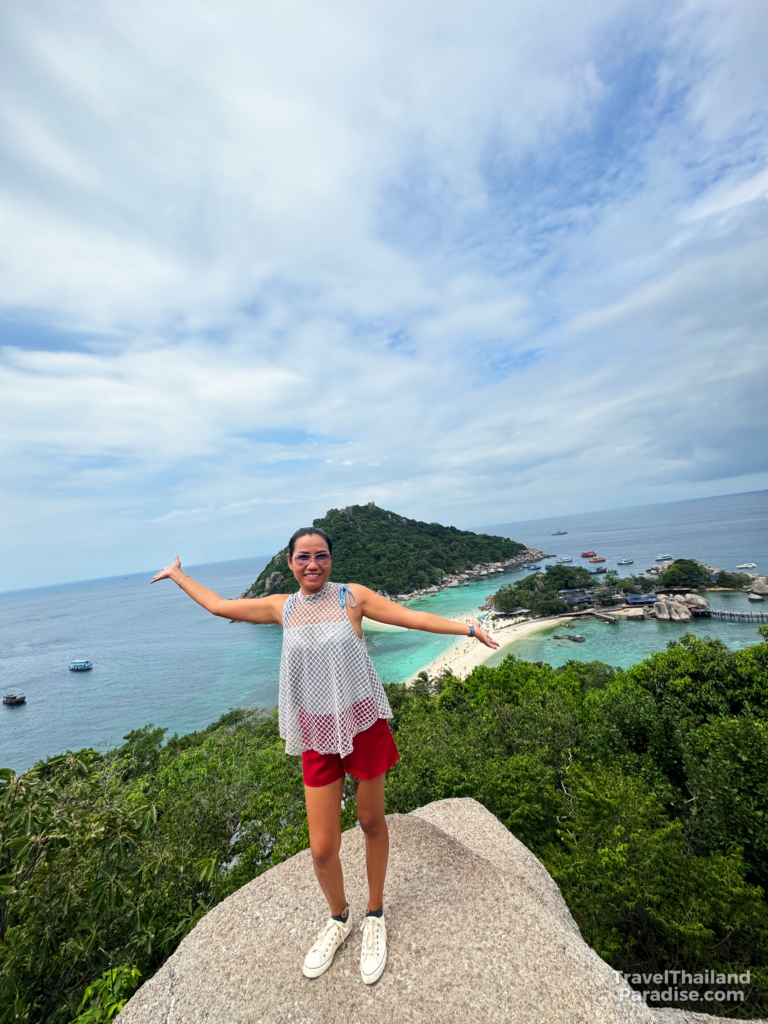
The viewpoint at Koh Nang Yuan Thailand is the one place where everything you’ve been trying to understand since arriving suddenly becomes clear. Until this point, your experience of the island is fragmented.
You see pieces of it—the sandbar, the water, one island at a time—but never the full picture. It’s visually impressive, but incomplete, almost like looking at a puzzle without seeing how the pieces connect.
The climb begins without much effort.
At first, it feels like a short walk rather than a hike. A visible path leads upward through shaded areas, giving you a false sense of simplicity. But within a few minutes, the terrain changes. The ground becomes uneven. Rocks replace flat surfaces. Steps appear, but not in a uniform way. You slow down, not because it’s difficult, but because it requires attention.
The heat adds another layer to the experience.
Even though the climb is relatively short, the combination of humidity and exposure makes it feel longer than expected. You become more aware of your breathing, of your pace, of each step you take. It’s not exhausting, but it’s enough to shift your focus inward for a moment.
And then the island begins to reveal itself.
Not all at once, but in fragments.
Through small openings between trees, you catch glimpses of the water below. A section of the sandbar appears for a second, then disappears again as the path curves. The color of the sea becomes more intense as your elevation increases. These brief moments create anticipation without fully satisfying it.
You keep moving.
And then, suddenly, the path opens.
You reach the viewpoint.
At that exact moment, everything connects.
The three islands are no longer separate pieces. They form a single composition, linked by a sandbar that curves naturally between them. The shape that felt confusing from below now feels completely logical, almost inevitable.
From above, the structure makes sense.
The water surrounding the islands shifts in layers. Closest to the sandbar, it’s pale turquoise, almost transparent. As it deepens, the color transitions into richer shades of blue, creating a gradient that feels smooth and continuous.
Boats, which seemed prominent from the water level, now look small and distant. People walking along the sandbar become part of the landscape rather than the focus of it. Movement below turns into patterns rather than individual actions.
But what makes this viewpoint more than just a visual highlight is how it evolves.
The longer you stay, the more you notice that nothing is fixed.
The position of the sun changes the entire scene. Light moves across the sandbar, shifting the brightness of the surface. Shadows from the surrounding trees stretch and retract. The color of the water deepens or softens depending on the angle.
Even the atmosphere changes.
Midday brings sharper contrasts, stronger light, and more visible activity below. Early morning and late afternoon soften everything, creating a calmer, more balanced image.
Most people don’t stay long enough to notice this. They climb up, take the photo they came for, and leave.
But if you remain there, even just for a little longer, something shifts in your perception.
You stop trying to capture the view.
And start experiencing it.
You realize that the image you’ve seen online—the one that brought you here—is only one version of this place. A single moment, frozen in time. But standing at the viewpoint, you’re watching something that’s constantly changing, constantly adjusting itself.
And that’s what makes it memorable.
Not the fact that it looks perfect.
But the fact that it never looks exactly the same twice.
Snorkeling, Timing, and What a Full Day at Koh Nang Yuan Thailand Actually Feels Like
Snorkeling at Koh Nang Yuan Thailand doesn’t feel like an activity you plan. It feels like something you fall into naturally, almost without deciding to do it.
After spending time on the sandbar or coming down from the viewpoint, the water becomes impossible to ignore. It’s too clear, too still, too accessible. You don’t need instructions or preparation. You step in, and within a few moments, the entire environment begins to unfold around you.
The transition is immediate.
Within just a few meters, the seabed changes from smooth sand to textured coral. The clarity of the water removes any sense of distance. You’re not looking at something far below—you’re looking directly into it, as if there’s nothing separating you from what’s underneath.
Light moves constantly across the reef.
Small ripples on the surface create shifting patterns below, making everything feel alive even before you notice the marine life. Then the fish appear—not gradually, but all at once. Schools of parrotfish, angelfish, butterflyfish move through the coral without hesitation.
They don’t react to your presence in the way you might expect. They continue their movement, as if you’re simply another part of the environment.
And that’s what defines snorkeling here. It doesn’t feel like observation. It feels like immersion.
You don’t chase anything. You don’t search. The experience comes to you.
Occasionally, something changes.
A darker shape moves quickly through the water, cutting across your field of vision. For a moment, everything else fades into the background. A blacktip reef shark passes through—fast, controlled, keeping its distance but close enough to remind you that this is not a curated space.
Then it disappears just as quickly as it arrived.
And everything returns to normal.
What makes this experience different from other snorkeling locations in Thailand isn’t necessarily the diversity of marine life. Places like Phi Leh Lagoon or Maya Bay offer equally impressive underwater environments.
The difference here is accessibility.
You don’t need to travel to reach it.
You’re already in it.
The Flow of a Full Day
What most people don’t realize is that Koh Nang Yuan Thailand isn’t just defined by what you do, but by how the experience changes throughout the day.
If you arrive early, everything feels calm.
The water is still. The sandbar is open. The colors are softer, less intense but more balanced. You move slowly without thinking about it, because there’s no pressure to do anything quickly.
This is the best time to walk the sandbar, to take in the space without interruption, to notice details that disappear later in the day.
Then, gradually, the island begins to shift.
Boats start arriving more frequently. The quiet atmosphere becomes layered with movement. You begin to notice more people, more sound, more energy.
By mid-morning, the balance changes.
The sandbar becomes active. People move across it in both directions. The water fills with snorkelers. The viewpoint has a steady flow of visitors climbing up and down.
At midday, everything reaches its peak.
The island is fully alive.
The same space that felt calm just hours before now feels dynamic, almost intense. The light is stronger, the colors sharper, the contrast between water and sand more pronounced.
This is when most people experience Koh Nang Yuan.
And for many, this is where the impression is formed.
But what happens next is just as important.
Because by early afternoon, the shift begins again.
Boats start leaving. The movement slows. The sandbar begins to open up. The water becomes less crowded.
The intensity fades.
By late afternoon, the island returns to something closer to how it felt in the morning.
Not identical—but similar enough that you recognize the rhythm.
And that’s what defines a full visit.
Not a single moment.
But the transition between them.
The Biggest Mistake Most People Make
The biggest mistake when visiting Koh Nang Yuan Thailand isn’t about logistics, timing, or even expectations.
It’s rushing.
Arriving, taking photos, climbing the viewpoint, stepping into the water for a few minutes, and leaving.
On paper, you’ve done everything.
But in reality, you’ve experienced almost nothing.
Because this island isn’t about checking off activities.
It’s about allowing enough time for the place to change around you.
If you only see it at one moment—especially midday—you miss the contrast that makes it interesting.
You miss the quiet version.
You miss the transition.
You miss the part that makes it feel different from every other destination.
Final Thoughts: Why Koh Nang Yuan Thailand Stays With You
Koh Nang Yuan isn’t the kind of place that overwhelms you with size or variety. It doesn’t offer endless things to do or multiple directions to explore. In fact, its entire experience can be understood within a relatively small physical space.
And yet, that’s exactly what makes it memorable.
Because what stays with you isn’t the scale of the island—it’s the way it changes.
If you think back to the beginning of the experience, it starts quietly. A short boat ride, a gradual shift in the color of the water, a shape on the horizon that doesn’t quite make sense at first. There’s no dramatic introduction, no moment that announces its significance.
Then you step onto the sandbar, and something feels different.
Not dramatically different. Not enough to stop everything you’re doing. But just enough to make you slow down, to look more closely, to notice details you might otherwise ignore.
As the day progresses, the island reveals more of itself.
It becomes active, filled with movement, energy, people experiencing the same place in their own way. And for a while, that version of Koh Nang Yuan becomes your reality.
But then it shifts again.
The movement fades. The space opens up. The water calms. And suddenly, the island feels different without actually changing at all.
That’s what makes it stand out.
Not the sandbar itself. Not the viewpoint. Not even the clarity of the water.
But the contrast between all of those moments.
Between stillness and movement.
Between quiet and activity.
Between expectation and reality.
And somewhere within that contrast, you realize that Koh Nang Yuan Thailand isn’t about what you do there.
It’s about how you experience it over time.
If you rush through it, it becomes just another stop—another place you’ve seen, photographed, and moved on from.
But if you allow yourself to stay longer, to see how it changes, to experience more than just one moment of it, then it becomes something else entirely.
Something that doesn’t just look good in photos.
But actually stays with you after you’ve left.


