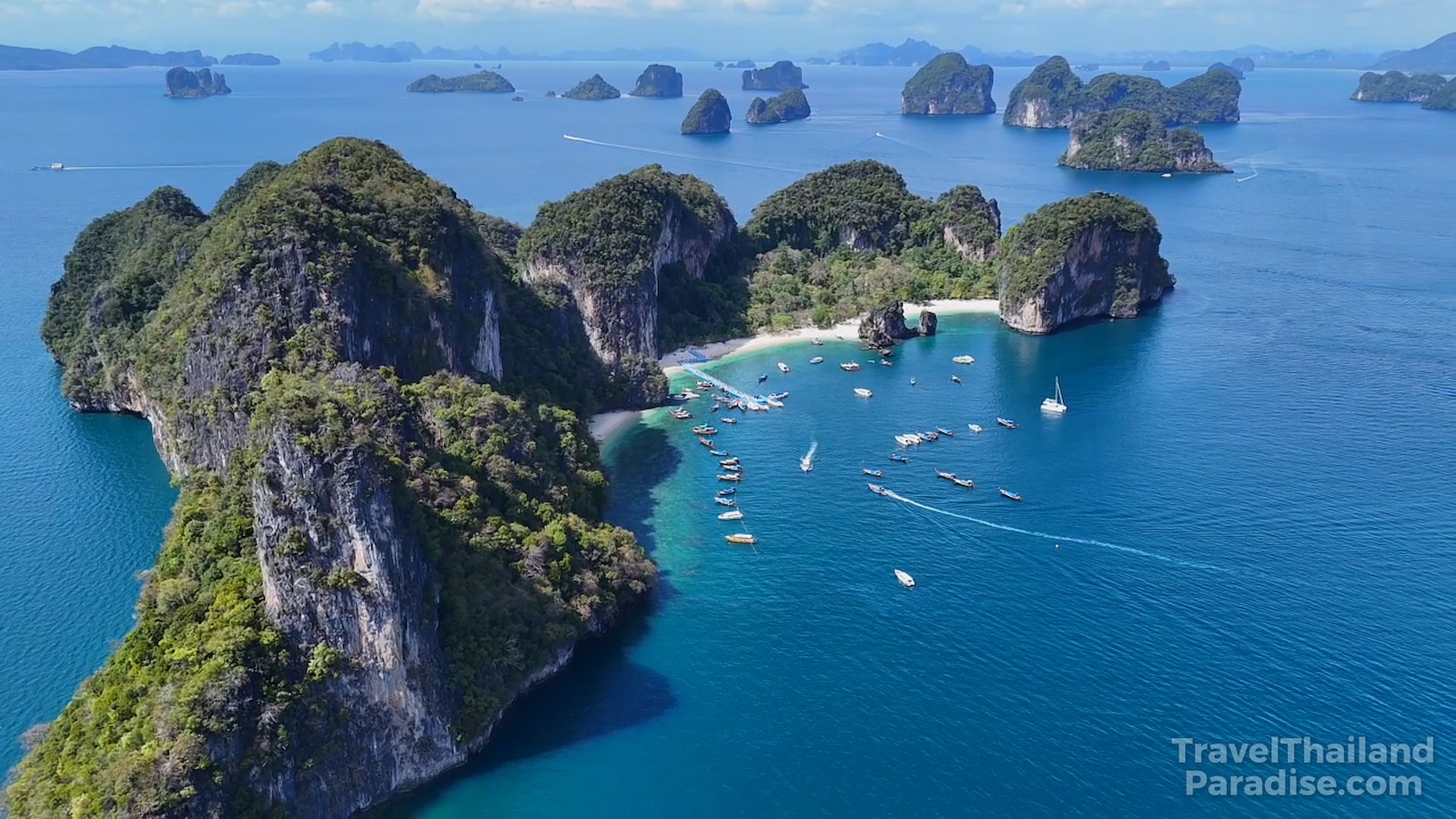
There are plenty of beautiful islands around Krabi, Thailand, but Hong Island Krabi has something that makes it immediately different from many of the others. It isn’t just about finding another white-sand beach surrounded by turquoise water. Here, towering limestone cliffs, a hidden lagoon, a tropical beach, and dozens of smaller islands scattered across the horizon all come together in one place.
And Hong Island changes depending on how you see it.
From a boat, the limestone formations seem enormous. From the beach, the water and surrounding cliffs become the focus. Inside Hong Lagoon, you suddenly find yourself almost completely enclosed by rock. And from high above, the shape of the island and the surrounding Andaman Sea reveal a landscape that is impossible to fully appreciate from ground level.
I’ve had the opportunity to see and film Hong Island from several different angles, including from the air, and that aerial perspective is one of the things that made the island particularly memorable for me.
But you don’t need a drone to understand why Hong Island has become one of Krabi’s most popular island trips.
There is plenty to experience at sea level.
Quick Navigation
In this Hong Island Krabi travel guide, I’ll cover:
- What Hong Island is really like
- Where it is and how to get there
- Hong Island Beach
- The famous Hong Lagoon
- The 360-degree viewpoint
- Swimming and snorkeling
- Longtail boats versus speedboats
- Group tours versus private tours
- Lao Lading and other nearby island stops
- The best time and season to visit
- Crowds and how they affect the experience
- How much time you need
- National park fees
- What to bring
- Photography and drone considerations
- Hong Island for solo travelers, couples, and families
- Common mistakes to avoid
- Hong Island versus other popular Krabi excursions
- And whether Hong Island is really worth adding to your Krabi itinerary
One thing I wouldn’t do is treat Hong Island as simply another quick stop where you jump off the boat, take a few photographs, and move on.
There is more here than that.
Give yourself enough time, and Hong Island becomes less about checking another Thai island off a list and more about experiencing one of the landscapes that makes the Krabi coastline so distinctive.
Where Is Hong Island Krabi?
Hong Island sits offshore from Krabi on Thailand’s Andaman coast and is part of Than Bok Khorani National Park. You may also see it called Koh Hong, Ko Hong, or Ko Lao Bi Le, depending on the map, tour company, or travel guide you’re looking at.
For most visitors staying around Krabi, however, the name you will see most often is simply Hong Island.
Ao Nang is one of the main jumping-off points for boat trips into the surrounding islands, and Hong Island is commonly combined with nearby places such as Lao Lading and Pak Bia on a day trip.
What matters more than the map coordinates is the setting.
Hong Island isn’t a resort island where you arrive to find streets, hotels, beach clubs, convenience stores, and restaurants stretching along the coast. The reason to come here is the natural landscape itself.
And you start seeing that landscape long before you step off the boat.
Arriving at Hong Island: When the Landscape Starts to Change
One of my favorite parts of visiting islands around Krabi is actually the journey between them.
Once you leave the developed coastline behind, the scenery begins to change. Buildings become smaller and eventually disappear. Open water takes over, and limestone formations start appearing across the horizon.
Some look like small green-covered rocks rising from the sea.
Others are enormous.
Hong Island belongs to the second category.
From farther away, it can initially blend into the other limestone islands scattered across this part of the Andaman Sea. But as the boat gets closer, the scale begins to reveal itself.
The cliffs become taller.
Individual trees become visible along the rock.
Different shades begin appearing in the water.
And the boats already sitting near the island suddenly look very small compared with the limestone behind them.
That was one of the things I noticed most about Hong Island: the closer you get, the more impressive it becomes.
There are destinations that photograph beautifully from a distance but lose some of their magic when you finally arrive.
Hong Island didn’t feel that way to me.
The approach actually made me more curious about what was ahead.
If you’re coming by traditional longtail boat, the slower journey adds something to the experience. You’re sitting close to the water, hearing the engine behind you and watching the island gradually become larger rather than simply racing toward it.
There is a point where you’re close enough that Hong Island no longer looks like another green shape on the horizon.
Now you’re looking upward at it.
And that change in perspective is difficult to communicate in photographs.
A limestone cliff occupying half of a picture can look impressive. Sitting in a relatively small boat directly underneath one makes the same cliff feel enormous.
Look beyond Hong Island and there isn’t simply empty ocean behind it.
More islands appear in the distance.
Some are little more than steep limestone formations covered in vegetation. Others stretch farther across the horizon. Depending on the weather, the most distant ones can almost fade into the haze.
It gives the impression that Hong Island is only one piece of a much larger landscape.
And it is.
But Hong Island immediately feels like the centerpiece.
The size alone gives it away.
As you get closer to the beach, the color of the water can begin changing as well. Deep blue farther offshore gives way to lighter shades over shallower areas, especially when the sun is strong enough to illuminate the sandy bottom.
This is one of those moments where I would take the photographs and video I want, but also put the camera down for a minute.
You only get your first approach once.

My aerial footage gives a completely different perspective on the approach to Hong Island, showing the limestone formations, surrounding Andaman Sea, and the scale of the island before reaching the beach.
First Impressions After Stepping Onto Hong Island
The perspective changes again once you’re off the boat.
From the water, the island dominates the horizon.
From the beach, the cliffs begin to dominate the sky.
That distinction sounds small until you’re actually standing underneath them.
You can look straight out toward beautiful turquoise water and boats floating offshore, then turn around and see dense tropical vegetation rising toward limestone behind you.
That combination makes the beach feel almost protected from the outside world.
And unlike some island stops where the beach itself is essentially the entire attraction, Hong Island immediately gives you choices.
You can swim.
You can explore the beach.
You can head toward the viewpoint.
You can photograph the cliffs.
You can simply find somewhere to sit and watch the longtail boats coming and going.
Or, depending on your itinerary, you may later continue around the island toward the famous Hong Lagoon.
Once you spend a little time here, you begin noticing details that don’t necessarily appear in the promotional photographs.
The sound of longtail boats approaching.
The enormous shadows cast by the limestone.
The changing color of the water as clouds move across the sun.
The contrast between busy sections near arriving boats and quieter moments farther away.
And perhaps most importantly, just how different the island looks depending on where you’re standing.
Hong Island doesn’t really have one signature view.
It has several.
Hong Island Beach: More Than Just Another Beautiful Krabi Beach
The main beach is where Hong Island starts to feel less like something you’re observing from a boat and more like somewhere you actually want to stay for a while.
At first glance, it has many of the ingredients you probably already associate with Krabi: pale sand, clear tropical water, longtail boats, dense vegetation, and enormous limestone formations surrounding the coastline.
But what makes Hong Island Beach memorable isn’t any one of those things individually.
It’s how tightly everything comes together.
You don’t have a wide, flat landscape where the mountains sit somewhere far in the background. Here, the limestone feels close. The vegetation begins almost immediately behind parts of the beach, and the cliffs rise so sharply that your eyes naturally move upward whenever you turn away from the sea. Similar experience I had when visited Phi Phi Don Island.
Then you turn back toward the water and the entire scene opens again.
On a sunny day, the contrast can be striking.
The water close to shore can appear very light, particularly where the bottom is sandy and shallow. Farther out, those lighter colors gradually transition into deeper shades of blue and green.
Add a few traditional longtail boats offshore and you have the kind of scene that could easily end up on a Thailand tourism poster.
Except you’re standing inside it.
And that is where I think Hong Island Beach works better in person than it does in a single photograph.
A photograph freezes the cliffs, water, and sand.
Standing there lets you see how everything changes.
A cloud moves across the sun and the turquoise water suddenly darkens.
The cloud passes and the color comes back.
A longtail boat approaches the beach.
Passengers climb out.
Another boat leaves.
For a few minutes one section may feel busy, and then suddenly it becomes much quieter again.
Hong Island Beach is constantly changing throughout the day.
That also means two people visiting only an hour apart can come away with surprisingly different impressions.
What Is the Water Like at Hong Island?
If conditions cooperate, this is definitely somewhere I would get into the water rather than simply photograph it.
You don’t need to turn every swim into an organized snorkeling expedition.
Sometimes swimming is enough.
Walk into the shallows, get away from the busiest part of the beach if possible, and look back toward the island.
This gives you another perspective that photographs taken from shore don’t really capture.
From the water, the beach becomes smaller and the limestone behind it seems even larger.
The swimming experience will obviously depend on the conditions during your visit.
Tides change the beach.
Wind affects the surface.
Rain can influence visibility.
Boat traffic varies.
And the Andaman Sea should always be treated as the sea, not as a swimming pool with guaranteed conditions.
If the water looks different from photographs you’ve seen online, that doesn’t necessarily mean something is wrong.
Tropical water is incredibly dependent on light.
I’ve seen the same stretch of water go from brilliant turquoise to a much darker green simply because clouds moved overhead.
Under strong sunlight, shallow sandy areas can almost glow.
Under cloud cover, those same areas become considerably darker.
It’s still the same water.
The light changed.
Can Hong Island Beach Get Crowded?
Yes.
And I think it’s much better to say that clearly than pretend otherwise.
Hong Island is not an unknown beach that only a handful of travelers have discovered.
It’s one of the best-known island excursions from the Krabi area.
Longtail boats and speedboats bring visitors throughout the day, and when several tours arrive close together, the atmosphere can change very quickly.
One moment you may have a relatively peaceful stretch of beach.
Then another boat arrives.
Then another.
Suddenly there are people swimming, taking photographs, organizing their bags, waiting for friends, listening to guides, and trying to figure out which boat they arrived on.
That doesn’t destroy the scenery.
The cliffs don’t become less impressive because fifty more people stepped onto the beach.
But crowds absolutely can change the atmosphere.
It isn’t secret.
And it doesn’t need to be.
A place can be famous and still be extraordinary.
An earlier departure can improve your chances of experiencing a quieter period, and a private boat gives you more flexibility with timing. But even during busy periods, visitor numbers tend to fluctuate as tour groups arrive and leave.
The realistic goal shouldn’t be having Hong Island entirely to yourself.
It’s finding enough space and time to appreciate it.
How Much Time Should You Spend on Hong Island?
There is an important distinction between seeing Hong Island and experiencing Hong Island.
You can see it quickly.
Step onto the beach, take a photograph, look at the cliffs, and technically you’ve been there.
But if you want to swim, walk around, enjoy the beach and climb the viewpoint, a short stop becomes restrictive very quickly.
I wouldn’t choose a tour based purely on the total number of destinations advertised.
Look at how much actual time you get on Hong Island.
For me, having enough time for the viewpoint without sacrificing the beach would matter far more than squeezing another minor photo stop into the itinerary.
The Hong Island 360° Viewpoint: Seeing Krabi From Above Without a Drone
If the beach shows you the beauty of Hong Island at sea level, the 360-degree viewpoint shows you where the island actually sits within the surrounding landscape.
Reaching it requires climbing.
And not just a symbolic staircase with twenty steps and a viewing platform at the top.
The viewpoint is reached by approximately 419 steps, rising to around 109 meters above sea level.
Four hundred nineteen steps may not sound terrible while you’re sitting in an air-conditioned hotel room reading this.
It can sound considerably more ambitious when you’re standing on a tropical island in Krabi with high humidity and the midday sun overhead.
This is not a race.
Take your time.
Bring water.
Wear something you can comfortably climb in.
And if you need to stop along the way, stop.
The island isn’t going anywhere.
The reward is a perspective you simply cannot get from the beach.
As you gain elevation, the relationship between Hong Island and the surrounding sea begins to change.
At ground level, the cliffs dominate your view.
From higher up, you begin looking across the landscape instead of upward at it.
The sea stretches much farther toward the horizon.
Other limestone islands appear around you.
Boats that looked reasonably large from the beach become tiny.
And suddenly the geography of this part of Krabi makes much more sense.
This is one reason I think the viewpoint is particularly worthwhile for travelers who don’t have access to aerial photography.
A drone can show you spectacular perspectives, but you’re watching those perspectives through a controller or screen.
At the viewpoint, you are physically standing inside the view.
There’s a difference.
You climbed there.
You feel the heat.
You feel the wind.
You can turn your head rather than moving a camera.
And when you look across the Andaman Sea and see limestone formations scattered in multiple directions, you begin to understand why Krabi is so difficult to describe with one photograph.
There is simply too much landscape.
Is the Hong Island Viewpoint Worth the Climb?
For most reasonably fit travelers, I would say yes.
Not because you need to prove that you climbed 419 steps.
The number is irrelevant once you’re at the top.
What matters is that the viewpoint adds an entirely different experience to your visit.
You already saw Hong Island from the boat.
You saw it from the beach.
You may have seen it while swimming.
Now you’re looking across it from above.
However, I wouldn’t tell every visitor that they absolutely must climb it.
If the heat is extreme, you’re exhausted from an already long island tour, you have mobility limitations, or you simply don’t enjoy steep climbs, skipping the viewpoint doesn’t mean you “did Hong Island wrong.”
Travel shouldn’t become a checklist of mandatory experiences.
There is nothing wrong with choosing another swim instead.
But if you’re standing at the bottom wondering whether the view is worth the effort?
I’d start climbing.
Because one of Hong Island’s most unusual landscapes is still waiting elsewhere.
It’s hidden behind the limestone.
And reaching it means getting back on the boat.
Hong Lagoon: The Hidden Room Inside the Island
Hong Island’s beach is immediately visible when you arrive.
Hong Lagoon is different.
From the open sea, you could travel alongside the island’s towering limestone walls without fully realizing what is hidden behind them. Much of the island appears solid from the outside: steep rock, dense vegetation, and cliffs dropping toward the water.
Then the boat turns toward an opening in the limestone.
At first, it doesn’t look particularly large.
That is part of what makes the experience so interesting.
You aren’t approaching a wide bay where the entire landscape is visible from hundreds of meters away. You are heading toward a relatively narrow passage between enormous limestone walls.
The closer you get, the more obvious it becomes that the opening leads somewhere.
And then you enter.
The open Andaman Sea begins disappearing behind the boat, the limestone walls move closer on either side, and within moments the landscape changes completely.
Instead of looking outward toward an endless horizon, you’re surrounded by cliffs.
This is Hong Lagoon, also known as Thale Nai.
And once you’re inside, the name of the island begins to make much more sense.
The Thai word hong translates roughly to “room.”
That’s essentially what the lagoon feels like.
A room hidden inside the limestone.
Except instead of walls built from concrete, you’re surrounded by cliffs rising out of tropical water.
The Entrance Is Part of the Hong Lagoon Experience
I wouldn’t think of Hong Lagoon simply as a destination.
The approach is part of it.
If you’re filming, keep the camera ready before entering.
If you begin recording only after the boat is already inside, you capture the lagoon but lose the reveal.
Open sea.
Limestone walls.
Narrow entrance.
Boat moving forward.
Then suddenly—
lagoon.
That transition tells the story much better than a static photograph ever could.
You may already know what’s coming.
You may have seen photographs or videos before your trip.
But entering through that opening at sea level still feels different.
What Does Hong Lagoon Actually Look Like?
The first thing you’ll probably notice is how enclosed everything feels compared with the open water outside.
The horizon largely disappears.
Instead, your view is dominated by limestone and vegetation.
The cliffs rise steeply around the lagoon, and dense tropical greenery covers portions of the rock wherever plants have managed to take hold.
Below them is shallow water that can take on beautiful shades of green and turquoise when the light and tide cooperate.
On a bright day, sunlight penetrating the shallower areas can make the water look almost luminous.
Under heavier cloud cover, the same lagoon can become darker and moodier.
Neither version is necessarily better.
They simply feel different.
Bright sun emphasizes the tropical water.
Clouds emphasize the cliffs.
Because the lagoon is enclosed, sounds can feel different too.
Boat engines become more noticeable.
Voices carry.
Water moves against the rock.
When there aren’t many boats inside, the place can feel surprisingly peaceful.
When several boats enter together, the atmosphere changes quickly.
But even then, the scale of the cliffs tends to pull your attention upward.
The Tide Can Completely Change Hong Lagoon
Hong Lagoon does not look exactly the same throughout the day.
The tide matters.
A lot.
During low tide, water inside the lagoon can become extremely shallow, potentially affecting how boats enter and move through it. At the time of my visit, it was low tide, so our boat was not able to enter inside the lagoon. Yet, still was able to capture the lagoon itself with my drone.
At higher water levels, the lagoon can look fuller and boats may be able to move farther inside.
At lower tide, shallow sections and the bottom become more visible.
Neither necessarily means you’ve arrived at the wrong time.
You’re simply seeing a tidal landscape doing what tidal landscapes do.
This is one reason I wouldn’t obsess over recreating a particular photograph.
Travel photographs freeze one moment.
Nature doesn’t.
Hong Lagoon changes with the tide, weather, sun angle, clouds, and number of boats.
Your visit will have its own version.
Should You Swim in Hong Lagoon?
I wouldn’t automatically assume Hong Lagoon is the main swimming stop of the trip.
Whether swimming is appropriate can depend on current park rules, tide, boat traffic, and instructions from your guide.
The lagoon’s biggest attraction for me is the landscape itself.
Inside, look upward.
Watch how close the cliffs feel.
Notice how the water color changes toward the edges.
Look back toward the narrow opening where you entered.
The lagoon is one of those places where a wide-angle photograph almost feels too small.
You really need movement to understand it.
Hong Lagoon From the Air
From inside the lagoon, you see walls.
From above, you see structure.
Suddenly you can understand where the lagoon sits in relation to the coastline.
You can see how limestone wraps around it and how the narrow opening connects the protected interior with the sea outside.
The boats provide scale.
From sea level, a longtail boat feels reasonably substantial.
From above, the same boat becomes a tiny object surrounded by enormous cliffs.
That’s why aerial footage here does more than produce a beautiful image.
It reveals geography you simply can’t see properly from inside.
What Else Is Included on a Hong Islands Tour?
A Hong Island tour doesn’t necessarily mean you’ll spend the entire trip on Hong Island.
Most excursions explore several locations around the wider Hong Islands area.
The exact itinerary depends on the operator, departure point, sea conditions, tour length, and sometimes the tide.
Common stops can include:
- Hong Island
- Hong Lagoon
- Lao Lading Island
- Pak Bia Island
- Nearby swimming or snorkeling locations
Some operators change the order depending on conditions.
I actually see that as an advantage.
If every boat followed exactly the same route at exactly the same time, each location would receive the same wave of visitors simultaneously.
A good captain may be able to adjust the sequence.
With a private boat, you can potentially have even more flexibility.
Lao Lading Island: A Completely Different Atmosphere
If your tour includes Lao Lading Island, don’t make the mistake of thinking it will simply feel like a smaller version of Hong Island.
It doesn’t.
Lao Lading has its own personality.
Hong Island impresses through scale.
Lao Lading feels more intimate.
Instead of the expansive feeling you get around Hong, Lao Lading’s beach sits inside a much smaller limestone cove.
The cliffs feel close.
The beach feels compact.
And when visitor numbers are reasonable, the setting can feel surprisingly secluded considering how close you are to one of Krabi’s most popular island-hopping routes.
This contrast is exactly why the two destinations work so well on the same trip.
You don’t need every island to be bigger and more spectacular than the previous one.
Sometimes changing scale is more interesting.
Hong Island says:
Look how enormous this landscape is.
Lao Lading says:
Look how beautiful this little corner is.
I’ve covered that destination separately in my Lao Lading Island Krabi Travel Guide, including what the beach is like, swimming, crowds, and what to expect during a typical stop.
Lao Lading Island Krabi Travel Guide: Everything You Need to Know
Pak Bia Island: Another Change of Scenery
Pak Bia is another location commonly associated with trips through the Hong Islands.
Again, the attraction is variety.
After Hong Island’s towering cliffs and hidden lagoon and Lao Lading’s enclosed little beach, Pak Bia gives the day another visual change.
Depending on tide and conditions, shallow water and exposed sandy areas can become part of the landscape, while neighboring limestone islands remain visible across the water.
This is where island hopping works best for me.
Not when you’re visiting five versions of essentially the same beach.
But when every stop changes the experience slightly.
Large island.
Hidden lagoon.
Small cove.
Shallow beach.
Snorkeling stop.
Open water.
Those transitions keep the day interesting.
Longtail Boat vs Speedboat to Hong Island: Which Would I Choose?
If you’re choosing between a longtail boat and speedboat for Hong Island, there isn’t one correct answer.
It depends on what kind of day you want.
A longtail boat gives you atmosphere.
You sit closer to the water.
The journey is slower.
You hear the distinctive engine.
You watch the islands gradually approach rather than racing between them.
And visually, those wooden boats belong in Krabi.
Seeing a colorful longtail beneath a massive limestone cliff is one of those scenes that immediately identifies southern Thailand.
A speedboat gives you efficiency.
If you have limited time, want to cover more distance, or simply prefer getting between stops quickly, it makes sense.
But speed changes the character of the journey.
For Hong Island, I personally lean toward the longtail boat if time isn’t an issue.
When you’re moving between limestone islands, passing small beaches and watching cliffs grow larger in front of you, I don’t necessarily want to get there as quickly as possible.
I want to see the journey.
That doesn’t make a longtail right for everyone.
If you’re traveling with very young children, prefer more speed and convenience, or have an ambitious itinerary, a speedboat may suit you better.
Sea conditions matter as well. A journey that feels comfortable on a calm morning can feel very different in rougher water.
The best choice is the one that fits the way you want to experience the day.
Group Tour or Private Boat to Hong Island?
Most visitors will probably choose a group tour, and there is nothing wrong with that.
Group tours are convenient.
Transportation is organized.
The route is planned.
Equipment is usually arranged.
And for solo travelers, they make far more financial sense than paying for an entire boat.
The tradeoff is control.
If you love Hong Island and want another hour there, the schedule may not allow it.
A private boat changes that relationship with time.
You’re paying for flexibility: potentially leaving earlier, adjusting how long you spend at different stops, waiting for better light, or simply moving at a more relaxed pace.
For couples, families, small groups, photographers, or anyone who places a high value on flexibility, I would at least compare private options.
A private longtail boat would probably be my personal choice.
It combines the traditional Krabi experience with control over the itinerary.
And if several people are sharing the cost, the difference compared with buying multiple group-tour tickets may be smaller than expected.
Compare the full package rather than just the headline price:
- National park fees
- Food and drinks
- Snorkeling equipment
- Hotel transfers
- Number of hours
- Departure point
- Maximum passengers
That’s the only fair way to judge value.
Best Time of Day to Visit Hong Island
If your goal is fewer people, I would favor an early start whenever possible.
That doesn’t guarantee an empty island.
Hong Island is too well known for that.
But starting earlier can improve your chances of arriving before the busiest portion of the standard tour cycle.
There is another factor besides crowds:
light.
Strong overhead sunlight can make shallow tropical water look spectacular because more light reaches the sandy bottom.
Earlier or later light can give the limestone more texture and dimension.
So there is a tradeoff.
Midday can produce incredible water color.
Earlier or later can create better atmosphere.
If you’re simply coming to swim and enjoy the island, don’t overthink it.
If you’re coming specifically to photograph or film Hong Island, timing becomes much more important.
When Is the Best Season to Visit Hong Island Krabi?
Hong Island sits on Thailand’s Andaman side, so conditions generally follow the broader Krabi weather pattern.
The drier part of the year usually provides the better odds for sunny skies and calmer island-hopping conditions, while the wetter monsoon period brings a greater chance of rain, wind, and rough seas.
The important word there is odds.
Weather seasons are not guarantees.
You can visit during a supposedly ideal month and get clouds.
You can visit during a wetter period and wake up to a beautiful sunny morning.
I’ve learned not to treat neat online weather charts as promises.
Tropical weather doesn’t read travel blogs.
During wetter periods, the main difference is increased uncertainty.
Rain showers become more likely.
Cloud cover may linger.
Sea conditions can deteriorate.
Boat itineraries can be modified.
In worse conditions, tours can be canceled entirely.
That doesn’t mean Krabi suddenly becomes unattractive.
The limestone scenery can look incredibly dramatic underneath darker skies.
But if bright turquoise water and aerial photography are major priorities, sunshine obviously helps.
Don’t Schedule Hong Island for Your Final Day in Krabi
If Hong Island is high on your priority list, try to schedule it earlier in your stay rather than on your final available day.
If weather causes the tour to be canceled or postponed, you’ll still have another opportunity.
This is particularly useful during less predictable weather periods.
It’s a small itinerary decision that can save a lot of disappointment.
Does Hong Island Still Look Good on a Cloudy Day?
Absolutely.
Just different.
Blue skies and sunshine are ideal for bringing out those classic tropical water colors.
Clouds, however, can transform the limestone landscape.
The vegetation looks deeper green.
Textures in the rock become more noticeable.
Distant islands can gradually fade into haze.
The biggest visual difference tends to be the water.
Turquoise water relies heavily on light. When sunlight reaches shallow water over a pale sandy bottom, the reflected light produces those bright tropical colors.
Put a thick cloud between the sun and the water and the color can change remarkably quickly.
From above, you can sometimes literally watch those colors change as cloud shadows move across the sea.
So don’t judge Hong Island based on one photograph taken under one set of conditions.
The landscape is constantly changing.
How Much Time Do You Need for a Hong Islands Tour?
If you’re visiting Hong Island together with Hong Lagoon, Lao Lading, Pak Bia, and perhaps a snorkeling stop, think in terms of a substantial half-day or full-day experience, depending on the itinerary.
The important question isn’t simply:
How many stops do I get?
Ask:
How much meaningful time do I get at them?
Every additional island requires travel, unloading, gathering passengers, and boarding again.
A well-paced itinerary lets the individual places feel different rather than turning the day into a race through a checklist.
What Should You Bring to Hong Island?
You don’t need to pack as though you’re heading into the wilderness for three days.
But there are a few things I would definitely bring.
Sun Protection
Hours around open water can mean considerable sun exposure.
Bring sunscreen appropriate for marine environments, sunglasses, a hat, and perhaps a lightweight shirt or rash guard if you burn easily.
Water
Bring enough to stay hydrated, particularly if you’re planning to climb the viewpoint.
Walking 419 steps in Krabi’s heat is not where you want to discover that your last bottle of water was left at the hotel.
A Dry Bag
For island hopping, I consider a dry bag one of the most useful things you can carry.
You’re repeatedly getting on and off boats, and even calm seas can mean splashes, wet swimwear, and dripping snorkeling equipment.
Keep electronics and valuables protected.
Waterproof Protection for Your Phone
A waterproof pouch is inexpensive and useful if you want photographs while standing or swimming in shallow water.
A Small Towel
Some tours provide one.
Others don’t.
Check beforehand.
Suitable Footwear
Flip-flops or sandals are practical around the beach and boat.
If you’re climbing the viewpoint, however, make sure your footwear feels secure on stairs.
You don’t need hiking boots.
You do need something that stays on your feet.
Thai Baht
Even with a prepaid tour, carrying some cash is sensible.
Park fees and small expenses may not always be included.
Camera or Action Camera
Some of Hong Island’s most interesting perspectives come from the water looking back toward the limestone.
If you’re carrying expensive camera equipment, protect it properly during the boat journey.
Saltwater and electronics are not friends.
Hong Island National Park Entrance Fee
Because Hong Island is part of Than Bok Khorani National Park, foreign visitors should expect a national park entrance fee.
At the time of writing, the published foreign visitor rate is 300 baht for adults and 100 baht for children.
However, always verify the current fee before traveling because rates can change.
Also check whether your tour price includes it.
One operator may advertise a lower price but charge the park fee separately, while another includes the fee along with transfers, lunch, and snorkeling equipment.
Compare the total cost, not just the number shown at the top of the booking page.
Food and Facilities on Hong Island
Hong Island is a national park destination, not somewhere I would visit expecting the convenience of a developed resort island. It is not like Koh Phi Phi Don, which is more developed, with bars and hotels along the shore.
That is part of its appeal.
You aren’t coming here for beachfront cafés, shopping streets, beach clubs, or rows of restaurants.
There are basic visitor facilities around the main visitor area, but your tour arrangements matter more when it comes to food.
Many organized trips include lunch, snacks, fruit, or drinking water, although exactly what you receive varies.
If you have dietary requirements or allergies, tell the operator in advance rather than waiting until lunchtime on an island to discover that the provided meal doesn’t work for you.
I would also carry a small snack regardless.
Swimming, sun, heat, climbing the viewpoint, and several hours on the water can turn breakfast into a distant memory surprisingly quickly.
Swimming or Snorkeling: What Is Hong Island Better Known For?
If I had to describe Hong Island’s biggest strengths, I wouldn’t put snorkeling at the very top.
That isn’t criticism.
It’s about expectations.
The main reason I would come here is the landscape.
The beach.
The cliffs.
The lagoon.
The viewpoint.
The surrounding islands.
The journey between them.
Many Hong Islands tours include snorkeling, but visibility, marine life, currents, weather, and the exact snorkeling location all vary.
If snorkeling is your number-one priority in southern Thailand, research destinations specifically for underwater quality. So far, my best experience I ever had with snorkeling, was at Surin Islands. Or at Similan Island.
If you want a spectacular island-hopping trip where snorkeling is one part of a much bigger experience, Hong Island makes far more sense.
And sometimes, just swimming is enough.
No checklist.
No need to search for anything underwater.
Just get into the water and look back toward those cliffs.
Is Hong Island Good for Solo Travelers?
Yes.
Hong Island is very easy to incorporate into a solo trip around Krabi.
Shared tours make the excursion financially practical without needing to organize a group yourself.
Boat trips can also be surprisingly social because you’re spending several hours moving between islands with the same people.
But once you’re on the beach, you’re still free to do your own thing.
Swim.
Take photographs.
Climb the viewpoint.
Or simply relax until departure time.
As a solo traveler, I wouldn’t pay for a private boat unless I specifically wanted control over timing for photography or filming.
In that situation, you’re paying for flexibility rather than privacy.
Is Hong Island Good for Couples?
Very much so.
For couples, particularly on a honeymoon or anniversary trip, a private longtail becomes more attractive because the cost is shared and the itinerary can feel much less structured.
The real benefit isn’t simply avoiding strangers.
It’s deciding how to use your time.
Stay longer somewhere you love.
Move through another stop more quickly.
Wait for a busy beach to settle down.
A wooden longtail, beautiful islands, swimming, and enough time to enjoy them can already feel special without turning the trip into an elaborate luxury excursion.
Visiting Hong Island With Children
Hong Island can work very well for families, but I would choose the tour carefully.
Parents sometimes see an itinerary with eight stops and think:
More places for the same money. Excellent.
Children may reach Stop Number Five and have a completely different opinion.
Look at the pace rather than the destination count.
Consider:
- Boat journey length
- Shade aboard the boat
- Child-sized life jackets
- Number of stops
- Meal arrangements
- Actual beach time
- Ease of getting on and off the boat
- Sea conditions
- Amount of downtime
The viewpoint is optional.
Some children may consider 419 steps an adventure.
Others may decide at Step 63 that their parents have made a terrible mistake.
Either way, the beach and boat trip provide plenty without requiring the climb.
What About Older Travelers?
Age itself isn’t necessarily the issue.
Mobility and comfort are more important.
The main challenges can be boarding boats, stepping onto beaches, heat, wet surfaces, and climbing stairs.
Traditional longtails can require more agility than walking onto a large passenger ferry.
If someone in your group has limited mobility, ask the tour operator specific questions:
How do passengers enter and exit the boat?
Will we need to step into shallow water?
Is there a ladder?
How much walking is required?
Can someone remain at the beach rather than climb the viewpoint?
Specific questions produce much more useful answers than simply asking whether the tour is suitable for older travelers.
Photography at Hong Island: Finding More Than the Obvious Shot
Hong Island is incredibly photogenic.
That also means it has been photographed an enormous number of times.
Take the classic compositions.
There’s nothing wrong with photographing a beautiful view simply because thousands of people have photographed it before.
Then start looking for something different.
One of the easiest ways to communicate scale is to include something recognizable.
A person.
A swimmer.
A kayak.
A longtail boat.
Without those references, an enormous limestone cliff can simply look like a rock.
Put a tiny boat underneath it and suddenly the viewer understands the scale.
And don’t automatically wait for every longtail boat to disappear from your photographs.
One or two boats can actually improve the composition.
They add scale, color, and something unmistakably Thai to the scene.
After you’ve captured the wide views, look for smaller details too.
Ropes.
Reflections.
Rock textures.
Footprints.
The edge where clear water meets sand.
Those photographs often tell the story of a place better than twenty nearly identical panoramas.
Hong Island From the Air: Where Everything Finally Makes Sense
From the beach, you experience individual pieces of Hong Island.
Sand.
Cliffs.
Water.
Vegetation.
Nearby islands.
Inside Hong Lagoon, your view becomes even more restricted because the limestone surrounds you.
A drone removes those boundaries.
Once you’re high enough, the pieces connect.
You can see the shape of Hong Island.
You can see where the beach sits against the limestone.
You can see shallow water transitioning into deeper sea.
You can see boats leaving trails across the surface.
And beyond everything, more limestone formations continue toward the horizon.
This is one of those destinations where aerial footage doesn’t simply provide a prettier version of what you already saw.
It explains the geography.
Hong Island is particularly impressive from above because the surrounding landscape gives the footage depth.
You’re rarely filming one isolated island against empty water.
There are layers.
Hong Island in the foreground.
Another limestone formation behind it.
More islands farther away.
Then haze.
Then horizon.
That depth is one of the things that makes aerial footage around Krabi so visually distinctive.
A Note About Flying a Drone at Hong Island
Hong Island is within a Thai national park, so don’t assume you can simply arrive and launch a drone.
Thailand has national drone registration and operational requirements, and protected areas can involve additional restrictions or permissions.
Seeing somebody else’s Hong Island drone video online does not prove that unrestricted flying is permitted.
That includes my footage.
Rules, authorization procedures, enforcement, and temporary restrictions can change.
Before bringing a drone specifically to Hong Island, check the current Thai aviation requirements and the current rules for operating within the relevant national park.
If authorization is required, arrange it beforehand. It is a very good idea if you have a Thai speaking friend, to let that friend handle the phone conversations, in order to get that approval letter, since most national park rangers have little to no English knowledge.
The aerial perspective is spectacular here, but no shot is worth creating problems with park authorities or operating somewhere you aren’t authorized to fly.
See Hong Island at Ground Level
Aerial footage gives you scale.
A walking video gives you reality.
From the ground, you hear the surroundings, see boats arriving, watch people moving around the beach, and understand how large the cliffs feel when you’re standing underneath them.
That’s why I like having both perspectives.
Common Mistakes to Avoid When Visiting Hong Island
Hong Island isn’t difficult to visit, particularly on an organized tour.
But a few mistakes can make the day unnecessarily rushed or uncomfortable.
Choosing a Tour Only Because It Has More Stops
Seven locations aren’t automatically better than four.
Read the itinerary and consider how much actual time you’ll have at the places you care about most.
Ignoring What’s Included in the Price
Check for national park fees, transfers, food, drinking water, snorkeling equipment, insurance, kayaking if applicable, and pickup surcharges.
The lowest advertised price isn’t necessarily the lowest final cost.
Ignoring the Weather
Clouds alone aren’t a reason to cancel an island trip, but significant wind, storms, and rough-sea warnings should be taken seriously.
Underestimating the Sun
Being in the water can make you feel cool while you’re still receiving considerable sun exposure.
Protect yourself accordingly.
Bringing Too Much
Every unnecessary item becomes something you need to carry, keep dry, and remember each time you leave the boat.
Arriving Unprepared for the Viewpoint
If you intend to climb, bring water and wear secure footwear.
Four hundred nineteen steps feel very different in Krabi’s humidity than they do on paper.
Hong Island vs the Four Islands Tour: Which One Should You Choose?
The famous Four Islands Tour and the Hong Islands Tour both offer classic Andaman Sea scenery, but they aren’t interchangeable.
The Four Islands route is typically associated with destinations such as Poda Island, Chicken Island, Tup Island, and the Phra Nang area, depending on the itinerary.
Its appeal comes from beaches, offshore limestone formations, snorkeling, and the famous sandbar visible under suitable tidal conditions.
Hong Island offers something different.
Here, the experience is built around the main island, Hong Lagoon, the 360-degree viewpoint, and nearby stops such as Lao Lading and Pak Bia.
If the lagoon and viewpoint immediately grab your attention, Hong has the advantage.
If sandbars and the classic Chicken Island/Poda scenery are higher on your list, the Four Islands route may suit you better.
If you have enough time, do both.
They’re different enough that the second trip shouldn’t feel like a repeat.
Hong Island vs Phi Phi Islands
Phi Phi gives you internationally recognizable places such as Maya Bay and Phi Leh Lagoon, along with the scenery surrounding Koh Phi Phi Leh and the developed island of Koh Phi Phi Don.
Hong Island feels more concentrated.
The main attraction combines beach, viewpoint, and lagoon within one island environment, while nearby stops expand the trip without requiring the same scale of journey.
If I were staying in Krabi for several days, I wouldn’t choose between them.
I’d give each its own day.
They are both examples of southern Thailand’s limestone geography, but they don’t tell the same story.
Hong Island vs Lao Lading: Don’t Choose
If your Hong Islands itinerary includes Lao Lading, visit both.
They complement each other precisely because they aren’t the same.
Hong Island is larger and more dramatic.
Lao Lading is smaller and more intimate.
Hong gives you the viewpoint and lagoon.
Lao Lading gives you a compact cove where the limestone seems to wrap around the beach.
Putting them on the same itinerary makes the day better.
Hong Island or James Bond Island?
These destinations both feature spectacular limestone scenery, but the experiences are very different.
James Bond Island is primarily about the iconic rock formation and the surrounding landscapes of Phang Nga Bay.
Hong Island is much more of a beach-and-water day.
You can swim, spend time on the sand, visit the lagoon, climb the viewpoint, and combine the main island with smaller nearby stops.
If I wanted swimming and tropical island scenery, I would choose Hong.
If I wanted to explore the surreal limestone landscape of Phang Nga Bay and see one of Thailand’s most recognizable formations, I would choose James Bond Island.
They’re different reasons to get on a boat.
Don’t Confuse Hong Island Krabi With Koh Hong in Phang Nga Bay
There is more than one place in southern Thailand called Hong Island or Koh Hong.
The destination covered in this guide is Hong Island Krabi, within the Mu Ko Hong area of Than Bok Khorani National Park.
Another Koh Hong lies in the Phang Nga Bay area and appears on different boat and kayaking itineraries.
If you search for Hong Island Thailand or Koh Hong tour, information about both can appear.
Check the itinerary and map before booking.
If the excursion includes Lao Lading and Pak Bia, you’re looking at the Hong Islands route discussed here.
If it centers on Phang Nga Bay, caves, kayaking, and James Bond Island, you may be looking at the other Koh Hong.
One name.
Two very different days.
Is Hong Island Too Touristy or Overrated?
Hong Island is popular.
Organized tours visit regularly, and you will probably share the beach with other travelers.
But “touristy” here doesn’t mean streets lined with bars, shopping malls, nightlife districts, or beachfront resorts.
Visitors come largely for the natural environment and leave again.
The limestone remains the biggest thing in your field of view.
The sea remains the way you arrive.
The lagoon is enclosed by cliffs rather than buildings.
Where disappointment sometimes happens is when someone compares the real island with an idealized photograph.
Maybe the photograph showed one longtail boat, empty sand, turquoise water and perfect blue sky.
Then you arrive at midday.
Several boats are there.
Clouds cover the sun.
The water looks darker.
That’s not evidence that Hong Island is overrated.
It’s evidence that real destinations have weather, tides, people, and changing light.
Judge Hong Island by the landscape rather than whether your visit perfectly recreates a photograph.
For me, the landscape still wins.
Who Might Not Enjoy Hong Island?
Hong Island isn’t automatically right for everyone.
If you strongly dislike boats, beaches, swimming, or island hopping, there are better ways to spend a day around Krabi.
People who experience severe seasickness may also want to consider conditions carefully.
And if you have very limited time and already have several similar island excursions booked, another boat day may not be the best use of your itinerary.
Travel guides sometimes act as though every famous attraction is mandatory.
It isn’t.
Choose the experiences that match the way you actually enjoy traveling.
Who Will Probably Love Hong Island?
If seeing limestone islands gradually appear across the water makes you reach for the camera, you’ll probably enjoy Hong Island.
If you like swimming beneath cliffs, you’ll probably enjoy it.
If you love landscapes and photography, there is endless material.
Couples can turn the trip into a slower private excursion.
Solo travelers can easily join shared tours.
Families can choose a comfortable itinerary.
And travelers who simply want one classic Krabi island-hopping experience have a very strong option here.
Hong Island doesn’t require a niche interest.
The landscape has broad appeal.
What I Would Do Differently on My Next Hong Island Trip
If I returned, I wouldn’t try to add more destinations.
I’d concentrate on timing.
I would start early if possible.
I would seriously consider a private longtail boat.
I’d make sure I had enough time at the main island to climb the viewpoint without sacrificing a swim.
And I would pay more attention to the tide and light around Hong Lagoon.
Having control over those details would add more to a second visit than squeezing another island onto the itinerary.
Is Hong Island Krabi Worth Visiting?
For me, the answer is yes.
Hong Island deserves its reputation as one of the standout island trips around Krabi, but not because of one famous photograph.
It’s the variety that makes it memorable.
You approach across open water and watch the limestone grow in front of you.
You step onto the beach and look upward at cliffs that seemed much smaller from a distance.
You swim and see the island from the water.
You climb above it and suddenly the surrounding Andaman Sea opens in multiple directions.
Then you get back onto the boat and enter a lagoon that was hidden behind the rock all along.
And from the air, the entire landscape changes again.
Hong Island keeps giving you different perspectives depending on where you stand.
That’s what separates it from a beach you visit, photograph, and forget.
Frequently Asked Questions About Hong Island Krabi
Where is Hong Island Krabi?
Hong Island is located off the coast of Krabi in southern Thailand’s Andaman Sea. It forms part of the Mu Ko Hong area within Than Bok Khorani National Park. Ao Nang is one of the most common departure points for visitors.
How do you get to Hong Island from Ao Nang?
The easiest way is by longtail boat or speedboat. You can join an organized Hong Islands tour or arrange a private boat. Many itineraries combine Hong Island with Hong Lagoon, Lao Lading, and Pak Bia.
Is Hong Island Krabi worth visiting?
Yes, particularly if you enjoy beaches, limestone scenery, swimming, viewpoints, and island hopping. Its combination of beach, 360-degree viewpoint, hidden lagoon, and surrounding islands makes it one of the most varied island excursions around Krabi.
How many steps are there to the Hong Island viewpoint?
The viewpoint is reached by approximately 419 steps. Krabi’s heat and humidity can make the climb feel harder than the number suggests, so bring water and take your time.
Can you swim at Hong Island?
Yes, swimming is one of the main activities at Hong Island Beach when conditions are suitable. Always follow current instructions from park staff and your boat crew.
Can you snorkel at Hong Island?
Snorkeling is commonly included on Hong Islands tours, although locations and conditions vary. I would consider snorkeling an additional activity rather than the primary reason to visit Hong Island.
What is Hong Lagoon?
Hong Lagoon is a shallow lagoon largely enclosed by towering limestone cliffs. Boats enter through a narrow opening from the sea, with access and water depth influenced by the tide.
What islands are usually included on a Hong Island tour?
Itineraries vary, but common stops include Hong Island, Hong Lagoon, Lao Lading Island, and Pak Bia Island, sometimes together with an additional swimming or snorkeling location.
Is a private Hong Island tour worth it?
It can be particularly worthwhile for couples, families, photographers, and anyone who values flexibility. Solo travelers primarily interested in sightseeing will generally find shared tours better value.
How long should I spend at Hong Island?
Allow enough time to enjoy the beach and swim, and considerably more if you intend to climb the viewpoint. When comparing tours, look at time spent at the main island rather than simply counting the number of advertised stops.
Is Hong Island Krabi the same as Hong Island in Phang Nga Bay?
No. This guide covers Hong Island Krabi within Than Bok Khorani National Park. Another Koh Hong is found in the Phang Nga Bay area and appears on different kayaking and boat itineraries.
Final Thoughts on Hong Island Krabi
The more islands you visit around Thailand, the harder it becomes for another tropical beach to surprise you.
Clear water becomes familiar.
Longtail boats become familiar.
White sand becomes familiar.
Even limestone cliffs eventually become something you’ve seen before.
That means the destinations I remember most aren’t necessarily the ones with the whitest sand or brightest water.
They’re the places where the landscape creates an experience.
Hong Island does that.
The boat approach creates anticipation.
The beach gives you the classic tropical setting.
The viewpoint changes your sense of scale.
Hong Lagoon hides an entirely different landscape behind the cliffs.
Nearby islands such as Lao Lading change the atmosphere again.
And the aerial perspective ties everything together.
Take the photographs.
Film the cliffs.
Climb the viewpoint if you can.
Enter the lagoon.
Swim.
But also give yourself a moment to simply look around.
For me, that’s usually when a beautiful destination stops feeling like another place on an itinerary and becomes somewhere I will actually remember.
For official updates, visa requirements, you can also check the Tourism Authority of Thailand website.


