Quick Navigation
Before You Visit Lao Lading Island
- Discover why Lao Lading Island is one of Krabi’s most overlooked tropical escapes, despite being included on many Hong Islands tours.
- Learn how to visit Lao Lading Island, what to expect upon arrival, and whether it’s worth adding to your Krabi itinerary.
- Find out the best time to visit, how long to stay, and what activities you can enjoy, including swimming, snorkeling, and photography.
- See the island from both the beach and above through original drone footage, offering a perspective few visitors experience.
- Read my firsthand impressions, practical travel tips, and honest opinion on whether Lao Lading Island deserves a place on your Thailand bucket list.
If you’ve ever searched for the most beautiful islands in Krabi, chances are you’ve come across places like Hong Island, Railay Beach, or the famous Phi Phi Islands. Yet tucked away among the towering limestone cliffs of the Andaman Sea lies a much smaller island that many travelers don’t even know by name until their boat begins to slow down.
Lao Lading Island may not have the worldwide reputation of its larger neighbors, but that’s exactly what makes it so memorable. Included on many Hong Islands island-hopping tours, this tiny tropical island combines emerald-green water, dramatic limestone formations, and a peaceful beach that feels surprisingly untouched considering its location. For many visitors, it ends up being one of the biggest surprises of the entire day.
As our longtail boat approached the island, the towering cliffs immediately drew my attention. They seemed to rise almost straight out of the sea, surrounding a small stretch of white sand hidden between dense tropical vegetation. From a distance, it didn’t look like a place where boats could even land. Only as we got closer did the narrow beach reveal itself, framed by crystal-clear water that shifted from deep blue to vibrant shades of turquoise.
What makes Lao Lading special isn’t its size or the number of attractions you’ll find here. In fact, compared to many other destinations in Krabi, there’s very little development at all. Instead, it’s the scenery, the peaceful atmosphere, and the feeling of discovering a place that many visitors simply pass through without fully appreciating.
In this Lao Lading Island, Krabi Travel Guide, I’ll share everything you need to know before visiting, including how to get there, what to expect, the best time to visit, swimming and snorkeling conditions, practical travel tips, and my own experience exploring the island both from the beach and from above with a drone. By the end of this guide, you’ll have a clear idea of whether Lao Lading Island deserves a place on your Krabi itinerary.
Where Is Lao Lading Island?
Hidden among the limestone islands of Krabi Province, Lao Lading Island sits in the heart of the Than Bok Khorani National Park, just a short boat ride from the famous Hong Island. Despite being included on many island-hopping itineraries, it often remains overshadowed by its better-known neighbor, which is one of the reasons many visitors arrive with few expectations. In my opinion, that’s actually part of its charm.
Unlike larger destinations where ferries arrive throughout the day, Lao Lading has no hotels, restaurants, shops, or permanent village. The island exists almost entirely as a natural stop on boat tours exploring the spectacular coastline between Ao Nang and Krabi Town. Most visitors spend anywhere from 20 to 45 minutes here before continuing to the next island, but even that short visit is enough to leave a lasting impression.
Most travelers reach Lao Lading as part of the popular Hong Islands Tour, which usually departs from Ao Nang, Nopparat Thara Beach, Klong Muang, or Railay Beach. Depending on the tour operator and sea conditions, the journey generally takes between 30 and 50 minutes by speedboat or longtail boat. Since the island isn’t served by scheduled public transportation, joining an organized tour or hiring a private boat is the only practical way to visit.
One of the things I enjoyed most about approaching Lao Lading was how little you can actually see from a distance. Unlike Hong Island, which gradually reveals its long beach as you get closer, Lao Lading remains partially hidden behind towering limestone cliffs. For a while, it almost looks as though the boat is heading straight toward a solid rock wall. Only during the final moments of the approach does the small crescent-shaped beach appear, tucked between the cliffs and dense tropical vegetation.
Because the island is protected as part of the national park, its natural character has been carefully preserved. There are no beach clubs, no rows of sun loungers, and no large developments competing with the scenery. Instead, visitors are greeted by jungle-covered cliffs, clear Andaman waters, and a beach that still feels remarkably untouched despite its growing popularity.
Although many travelers remember Hong Island as the highlight of the day, I found Lao Lading offered something different. It wasn’t about spending hours on the beach or finding endless activities. It was about appreciating a small piece of Krabi that still feels wild, peaceful, and beautifully framed by nature. Sometimes the places that leave the biggest impression aren’t the largest or the most famous—they’re the ones that make you pause the moment you arrive.
My First Impression of Lao Lading Island
Every island has a different feeling when you first arrive. Some impress you from miles away, while others slowly reveal their beauty as you get closer. Lao Lading belongs to the second group.
As our boat made its final approach, the towering limestone cliffs became so dominant that they almost completely hid the beach behind them. From a distance, it looked as though there was nowhere to land at all. The cliffs rose almost vertically from the sea, covered with lush tropical vegetation that seemed to grow directly out of the rock. It was only during the last few moments before reaching the shore that the small strip of white sand finally came into view.
The first thing that caught my attention wasn’t the beach itself—it was the color of the water. Around the boat, the Andaman Sea changed through several shades of blue and green, becoming lighter with every meter we moved closer to shore. The clarity made it easy to see the sandy bottom beneath the surface, giving the entire bay an almost unreal appearance under the tropical sun.
Stepping onto the beach, I immediately noticed how compact the island felt. Unlike many of Thailand’s larger beaches, Lao Lading doesn’t stretch for hundreds of meters. Instead, everything feels close together. The cliffs surround you, the jungle begins only a few steps from the sand, and the sea is never more than a short walk away. Rather than making the island feel small, this creates a sense of being tucked inside a natural amphitheater, where towering limestone walls become the backdrop to every photograph.
One thing I particularly appreciated was how untouched the surroundings felt. There were no loud beach bars competing with the sound of the waves, no rows of umbrellas covering the sand, and no large buildings interrupting the scenery. Apart from a few arriving boats and other visitors exploring the shoreline, nature remained the main attraction. It reminded me that some of Thailand’s most memorable places don’t need luxury resorts or endless facilities—they simply need to be left as they are.
Having visited several islands around Krabi and Phang Nga Bay, I also couldn’t help comparing Lao Lading with some of the more famous destinations. While Hong Island impresses with its long beach and spacious lagoon, Lao Lading offers something more intimate. The island feels enclosed, almost hidden from the outside world, as if nature intentionally tucked it between the surrounding limestone cliffs. That first impression stayed with me long after we had continued to the next stop on our island-hopping tour.
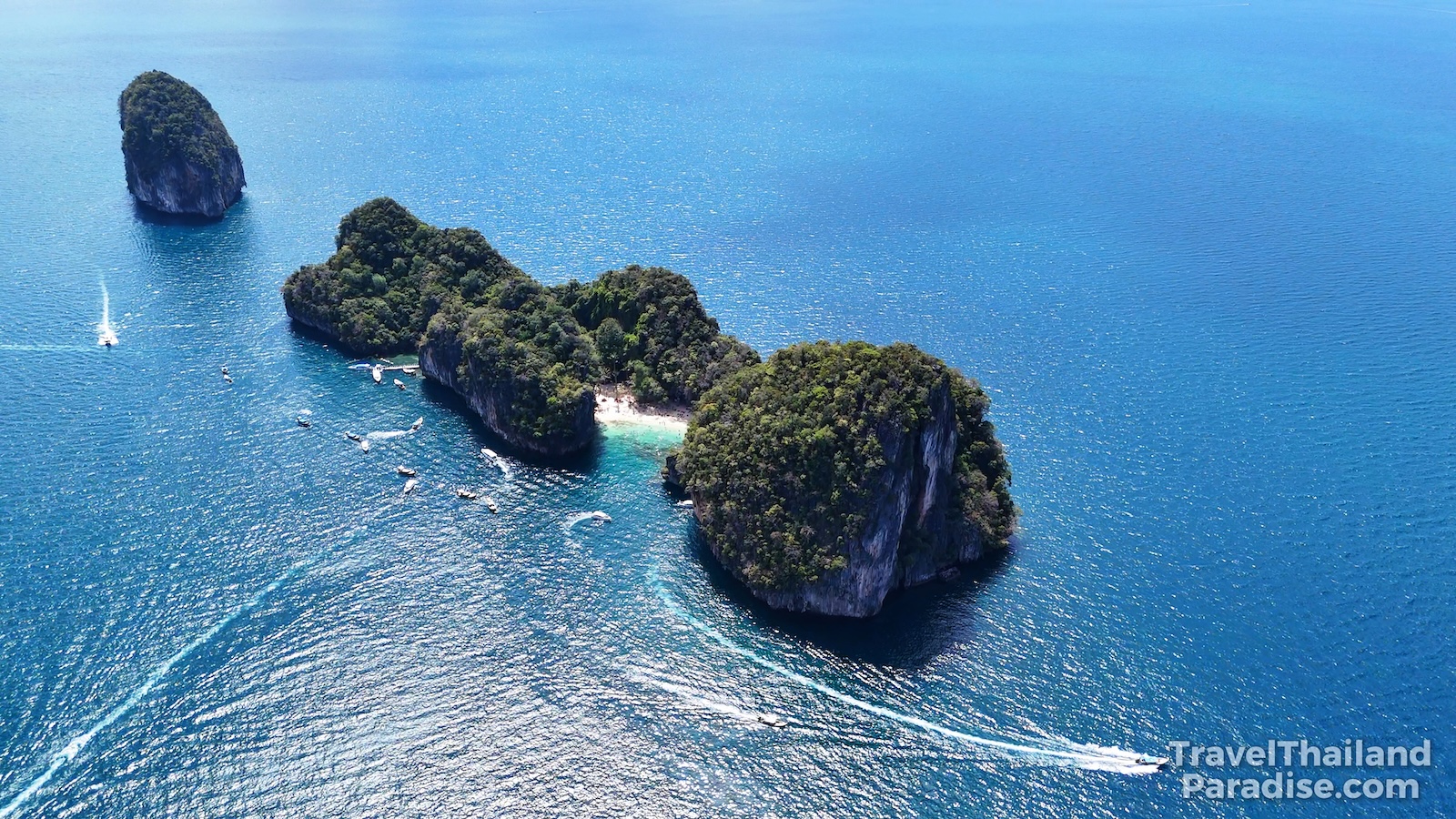
As I later reviewed the drone footage from above, I realized something I hadn’t fully appreciated while standing on the beach. From the ground, you’re surrounded by cliffs, making it difficult to understand the island’s overall shape. From the air, however, Lao Lading reveals itself as a tiny green jewel floating in the Andaman Sea, with its sheltered beach protected by dramatic limestone formations on nearly every side. It was a perspective that made me appreciate the island even more and confirmed why it has become one of my favorite hidden stops near Krabi.
What Makes Lao Lading Island So Special?
Some islands impress you because they’re filled with attractions. Others become unforgettable because of how they make you feel. For me, Lao Lading belongs firmly in the second category. There isn’t a long list of landmarks to check off or countless activities competing for your attention. Instead, the island’s beauty comes from the way all of its natural elements work together to create an atmosphere that feels surprisingly peaceful.
The first thing that stands out is the dramatic landscape. Towering limestone cliffs surround much of the island, creating a natural barrier that separates it from the open sea. Covered in dense tropical vegetation, these cliffs give Lao Lading a wild appearance, almost as if it has been untouched for centuries. Even when other tour boats are anchored nearby, the cliffs help create a sense of privacy that you don’t always find on larger beaches.
The beach itself is relatively small, but that’s part of its character. Instead of walking for long distances, you’re encouraged to slow down and simply take in the surroundings. Soft sand meets crystal-clear water only a few steps from the jungle, making it easy to move between swimming, relaxing, and exploring without ever feeling rushed. It’s one of those places where you naturally spend more time looking around than checking your watch.
One of my favorite moments was simply standing near the shoreline and looking back toward the island. From that angle, the limestone cliffs seemed even taller than they had from the boat, while the surrounding jungle added layer after layer of rich green color. The contrast between the white sand, emerald water, and dark gray rock created a landscape that almost looked too perfect to be real. It’s easy to understand why photographers are drawn to this place.
Another reason Lao Lading stands out is that it still feels relatively natural. There are no large resorts overlooking the beach, no shopping streets, and no noisy entertainment venues competing for your attention. That simplicity allows the island to remain the main attraction. You come here to appreciate nature, not to fill your day with activities.
Of course, the experience can vary depending on when you arrive. During the busiest hours, several tour boats may visit at the same time, making the beach feel more crowded than its size would suggest. Fortunately, those stops are usually short. As one group leaves and another prepares to continue its journey, the atmosphere changes quickly. If you’re lucky enough to visit during one of those quieter moments, Lao Lading becomes remarkably peaceful, with little more than the sound of gentle waves and the occasional longtail boat in the distance.
Looking back, I don’t think it was any single feature that made Lao Lading memorable. It wasn’t just the cliffs, the beach, or the clear water. It was the combination of all those elements packed into such a compact space. Every direction offered a different view, whether I was standing on the sand, walking along the shoreline, or later watching the drone footage from above. Few places manage to feel both dramatic and peaceful at the same time, but Lao Lading does exactly that.
Can You Swim at Lao Lading Island?
If you’re wondering whether Lao Lading Island is just a quick photo stop or a place where you can actually enjoy the water, the answer is yes. Swimming is one of the main reasons people step off the boat, and on a calm day, it’s hard to resist the inviting shades of turquoise that surround the beach.
During my visit, the water was exceptionally clear. Even while standing near the shoreline, I could easily see the sandy bottom beneath my feet. The gentle slope into the sea made entering the water easy, and within just a few steps, the refreshing temperature provided welcome relief from the tropical heat. Looking back toward the beach from the water offered a completely different perspective, with the limestone cliffs appearing even more dramatic than they did from the shore.
One thing I appreciated was how calm the bay felt. Because the beach is partially protected by the surrounding rock formations, the water is often much gentler than on more exposed beaches along Thailand’s coastline. Of course, sea conditions can always change depending on the weather and the season, but many visitors are greeted by calm, crystal-clear water that’s perfect for a relaxing swim rather than battling waves.
The beach itself isn’t particularly large, so you won’t find long stretches of open water to swim across like you might at Nai Harn Beach or Kamala Beach. Instead, Lao Lading encourages a slower pace. Most people spend their time floating in the warm water, cooling off after the boat ride, or simply enjoying the scenery from a different viewpoint. Sometimes the best experience isn’t swimming long distances—it’s taking a moment to appreciate where you are.
If you’re visiting on a Hong Islands tour, keep in mind that your time on the island is usually limited. Tour operators often schedule several stops throughout the day, so it’s worth making the most of the time you have. If swimming is high on your priority list, I’d recommend getting into the water fairly soon after arriving rather than waiting until the final few minutes before departure.
Although Lao Lading isn’t known as a dedicated snorkeling destination, you may still spot small tropical fish in the shallower areas, especially when the water is calm and visibility is good. However, if your main goal is snorkeling, nearby locations on the same island-hopping route may offer more marine life and a greater variety of underwater scenery. I found Lao Lading’s greatest strength wasn’t what lay beneath the surface—it was everything surrounding it above the water.
For me, swimming here wasn’t about ticking another beach off a list. It was about taking a short break from the boat, looking up at the towering cliffs, and appreciating just how different this tiny island felt from many of Thailand’s larger beaches. Sometimes those quiet moments become the memories you remember long after the trip is over.
Seeing Lao Lading Island From Above
Standing on the beach, it’s easy to admire Lao Lading’s towering cliffs and crystal-clear water. What you don’t fully realize from ground level is how perfectly the island is shaped by nature. It wasn’t until I reviewed my drone footage later that I truly appreciated just how unique this small island is.

From above, Lao Lading looks like a hidden oasis surrounded by towering limestone formations. Dense tropical jungle covers most of the island, leaving only a small crescent-shaped beach exposed along the shoreline. The contrast between the rich green vegetation, the white sand, and the different shades of turquoise water creates a scene that is difficult to appreciate while standing on the ground.
One of the most striking details visible from the air is how protected the beach really is. The surrounding cliffs act almost like a natural shield, helping create the calm bay that visitors enjoy once they step off the boat. Looking down from above, it’s much easier to understand why the water often remains so clear and inviting. The island almost feels like a small natural harbor carved into the coastline over thousands of years.
The aerial perspective also reveals just how compact Lao Lading really is. From the beach, the cliffs dominate your view, making the island seem much larger than it actually is. Once the drone climbs higher, however, the entire island fits comfortably within a single frame, emphasizing its intimate size while highlighting the dramatic landscape that surrounds it.
As the drone continues to gain altitude, another detail becomes apparent. Lao Lading isn’t an isolated destination sitting alone in the Andaman Sea. Instead, it’s part of an extraordinary chain of limestone islands scattered across the waters of Krabi Province. From above, you begin to appreciate how closely these islands are connected, each with its own distinctive shape, hidden beaches, and sheltered bays. It’s a perspective that reminds you this isn’t just one beautiful island—it’s part of one of Thailand’s most spectacular coastal landscapes.
For photographers and drone enthusiasts, Lao Lading offers endless opportunities to capture changing light, vibrant water colors, and dramatic shadows cast by the surrounding cliffs. Depending on the position of the sun, the island can look completely different throughout the day. Morning light often produces bright, vivid colors, while later in the afternoon the cliffs create deeper shadows that add even more contrast to the scenery.
Looking back at the footage after returning home, I realized that some of my favorite memories weren’t recorded while standing on the beach at all. They were the moments captured from above, showing the island in its entirety. The drone revealed details that simply weren’t visible from ground level and gave me a new appreciation for how nature shaped this remarkable corner of Krabi.
How to Visit Lao Lading Island
Unlike some of Thailand’s larger islands, you can’t simply catch a ferry or arrive independently at Lao Lading Island. The island has no pier for scheduled passenger boats, no accommodation, and no permanent transportation services. The vast majority of visitors experience it as part of a day trip exploring several nearby islands, making a tour the easiest and most practical way to get there.
Most travelers visit Lao Lading as part of the popular Hong Islands Tour, one of Krabi’s best island-hopping experiences. Depending on the tour operator, the itinerary often includes Hong Island, Hong Lagoon, Lao Lading Island, and one or two additional stops for swimming, snorkeling, or sightseeing. Although the order of the stops may vary, Lao Lading is frequently included because of its beautiful beach and sheltered bay.
Tours usually depart from Ao Nang Beach, Nopparat Thara Beach, Klong Muang, or Railay Beach, giving visitors several convenient starting points depending on where they’re staying. Both traditional longtail boats and modern speedboats operate these routes, and each offers a different experience.
Choosing between a longtail boat and a speedboat depends on the type of trip you’re looking for. Speedboats reach the islands more quickly, allowing extra time at each stop and making them a popular choice for visitors trying to see as much as possible in a single day. Longtail boats, on the other hand, provide a slower and more traditional journey. Cruising across the Andaman Sea in one of Thailand’s iconic wooden boats adds a sense of authenticity that’s difficult to replace, especially as the limestone cliffs gradually come into view.
If you prefer more flexibility, hiring a private longtail boat can be an excellent option. A private charter allows you to decide how much time to spend at each island instead of following a fixed group schedule. That can make a noticeable difference at Lao Lading, where organized tours often stop for only a short visit before continuing to the next destination.
Because Lao Lading is part of Than Bok Khorani National Park, visitors should also be prepared to pay the applicable national park entrance fee if it isn’t already included in their tour package. Before booking, it’s worth confirming exactly what’s covered, as some operators include the fee in the advertised price while others collect it separately on the day of the tour.
One tip I’d strongly recommend is checking the itinerary rather than booking the cheapest tour available. At first glance, many Hong Islands tours appear almost identical, but small differences can have a big impact on your experience. Some operators allow more time at each stop, while others spend longer traveling between islands or include additional snorkeling locations. Spending a few extra minutes comparing itineraries can make the day feel much less rushed.
If your goal is simply to visit Lao Lading, almost any Hong Islands tour will get you there. However, if you enjoy photography or want enough time to appreciate the scenery without constantly watching the clock, choosing a well-reviewed operator or arranging a private boat is well worth considering. For me, islands like Lao Lading are best enjoyed at a relaxed pace. Even an extra twenty or thirty minutes can completely change the experience.
Lao Lading Island vs Hong Island: Which One Is Better?
Since most visitors see both islands on the same day, it’s natural to wonder which one leaves the stronger impression. The answer depends on what you’re looking for because, although they’re located only a short boat ride apart, the experience on each island feels surprisingly different.
Hong Island is undoubtedly the more famous destination. It features a larger beach, more room to spread out, and generally allows visitors to spend more time swimming or relaxing along the shoreline. It’s often considered the centerpiece of the Hong Islands tour, attracting travelers from around the world with its soft white sand and crystal-clear water.
Lao Lading Island, on the other hand, offers a completely different atmosphere. The beach is much smaller, and instead of wide open views, you’re surrounded by towering limestone cliffs that create a feeling of being tucked away inside a natural cove. Everything feels more intimate. Rather than inviting long walks along the beach, Lao Lading encourages you to slow down, take in the scenery, and simply appreciate the island’s natural beauty.
From a photographer’s perspective, I found both islands rewarding for different reasons. Hong Island provides broad panoramic views with plenty of open space, making it ideal for classic tropical beach photographs. Lao Lading, however, feels more dramatic. The towering cliffs create stronger contrasts, while the enclosed beach offers interesting compositions from almost every angle. If I had to choose the more photogenic location, Lao Lading would probably have a slight advantage simply because its landscape feels more unique.
The experience becomes even more different when viewed from above. While Hong Island impresses with its long stretch of coastline and famous lagoon, Lao Lading reveals an almost perfectly hidden beach protected by steep limestone formations. Looking at the drone footage later, I realized that the island’s beauty isn’t fully appreciated until you see its entire shape from the air. It was one of those moments where the aerial perspective completely changed how I remembered the destination.
Crowds can also influence your experience. Because Hong Island is the main attraction on most tours, it often feels busier, especially during the middle of the day. Lao Lading usually receives shorter visits, meaning the number of people changes constantly as tour boats arrive and depart. Depending on your timing, you might find yourself sharing the beach with several groups—or enjoying a surprisingly peaceful atmosphere only minutes later.
If your priority is spending several hours swimming and relaxing, Hong Island is probably the better choice. It offers more space and generally allows visitors to spread out comfortably. If, however, you’re looking for dramatic scenery, incredible photography opportunities, and a destination that feels a little more secluded, Lao Lading has a character that’s difficult to match.
Personally, I wouldn’t choose one instead of the other. I think that’s the wrong way to look at them. Hong Island and Lao Lading complement each other rather than compete with each other. Hong Island delivers the classic tropical beach experience that most travelers imagine before arriving in Krabi, while Lao Lading provides a quieter, more intimate setting that feels like a hidden discovery. Visiting both on the same tour gives you two completely different perspectives of the Andaman Sea, and together they create a much richer experience than either island could offer on its own.
Best Time to Visit Lao Lading Island
Like many islands along Thailand’s Andaman Coast, Lao Lading can be visited throughout much of the year, but your experience will vary depending on the season and even the time of day. While the island’s dramatic scenery remains the same, weather, sea conditions, and visitor numbers can make each visit feel quite different.
For most travelers, the dry season between November and April offers the best overall conditions. Calm seas, blue skies, and excellent visibility make boat transfers smoother and bring out the vibrant colors that make Krabi’s coastline so famous. During these months, the water often appears at its clearest, making it ideal for swimming, photography, and simply enjoying the scenery.
The green season, which generally runs from May to October, has a different character. Short tropical showers are more common, and rougher seas occasionally affect island tours. Some days remain sunny with only brief afternoon rain, while others may see tours postponed or cancelled because of weather conditions. If you’re traveling during this period, keeping your itinerary flexible is always a good idea.
The time you arrive can be just as important as the month you visit. Since Lao Lading is included on many island-hopping routes, the atmosphere changes throughout the day as different tour boats come and go. Some groups stay only a short time before continuing to the next stop, meaning the beach can feel lively one moment and surprisingly peaceful the next.
If you’re booking a private longtail boat, you’ll have much greater flexibility. Starting earlier in the morning or visiting later in the afternoon may allow you to enjoy the island with fewer people around, creating a much quieter experience than those following standard group itineraries. For photographers, this flexibility can also provide softer natural light and more opportunities to capture the island without boats dominating every frame.
Another factor worth considering is the tide. While Lao Lading remains beautiful in different conditions, the appearance of the beach changes slightly as the water level rises and falls. During lower tides, more of the sandy shoreline becomes visible, while higher tides bring the turquoise water closer to the jungle, creating a different but equally beautiful setting.
If your main goal is photography, clear skies after a passing rain shower can produce some of the most vivid colors you’ll see in southern Thailand. The limestone cliffs appear darker, the surrounding vegetation becomes a richer shade of green, and the sea often reflects an incredible range of blue and emerald tones. Sometimes waiting a few minutes after the weather clears can be more rewarding than having uninterrupted sunshine all day.
Personally, I don’t think there’s a single “perfect” moment to visit Lao Lading Island. Every season and every hour offers something slightly different. What matters most is allowing yourself enough time to appreciate the island rather than treating it as just another quick stop on a busy itinerary. Even a short visit feels much more rewarding when you slow down, look around, and take in the scenery instead of immediately thinking about the next destination.
Things to Know Before Visiting Lao Lading Island
Although visiting Lao Lading Island is relatively straightforward, a little preparation can make your experience much more enjoyable. Since most people only spend a limited amount of time here, being ready before the boat arrives allows you to focus on the scenery instead of searching through your backpack.
Bring only what you’ll actually need
Most Hong Islands tours involve getting on and off the boat several times throughout the day. Carrying a large backpack quickly becomes inconvenient, especially when stepping into shallow water during beach landings. A small daypack with your essentials is usually more practical.
Pack a waterproof bag
Whether you’re traveling by longtail boat or speedboat, there’s always a chance that your belongings may get splashed during the journey or while boarding the boat. A simple dry bag provides inexpensive protection for your phone, wallet, camera batteries, and other valuables.
Wear footwear that’s easy to remove
Depending on the tide and the type of boat, you may need to step directly into shallow water before reaching the beach. Sandals or water shoes are often much more comfortable than sneakers, which can quickly become wet and uncomfortable.
Protect yourself from the tropical sun
There isn’t much shade along the beach itself, particularly during the middle of the day. Sunscreen, sunglasses, and a hat can make a significant difference, especially if you’re spending several hours island hopping before returning to Krabi.
Respect the natural environment
One of the reasons Lao Lading remains so beautiful is that it has largely been left in its natural state. Staying on established paths, avoiding damage to vegetation, and taking all rubbish back with you helps preserve the island for future visitors.
Don’t expect modern facilities
Lao Lading isn’t a developed tourist destination. You won’t find rows of restaurants, beach clubs, or shopping areas waiting for you. That’s part of its appeal. It’s a place to appreciate nature rather than convenience, so arriving with realistic expectations will make the experience much more enjoyable.
Put the camera down for a few minutes
As someone who enjoys both photography and flying drones, I know how tempting it is to document every moment. Still, one of my favorite memories from Lao Lading wasn’t captured by a camera. It was simply standing at the water’s edge, listening to the gentle waves while looking up at the towering limestone cliffs. Sometimes the moments you don’t photograph become the ones you remember most.
Is Lao Lading Island Worth Visiting?
If you’re expecting an island packed with restaurants, beach bars, water sports, or enough activities to fill an entire day, Lao Lading probably isn’t the destination you’re looking for. That’s not a criticism—it’s simply not the purpose of this island.
Lao Lading is about slowing down.
It’s the kind of place where you arrive, take a deep breath, and immediately realize that the scenery does all the talking. There are no attractions competing for your attention because the island itself is the attraction. For many visitors, that simplicity becomes one of its greatest strengths.
What impressed me most wasn’t a single viewpoint or one unforgettable photograph. It was the overall atmosphere. Even though I knew the island was part of a popular Hong Islands tour, it never felt overdeveloped or artificial. Instead, it still had the feeling of a place where nature remains in control. Walking only a short distance along the beach was enough to appreciate how dramatically the landscape changed depending on where you stood. Every few steps revealed a different angle, a different composition, and another reason to stop and simply look around.
I also think Lao Lading benefits from something that can’t easily be measured on a map—expectations. Before arriving, many travelers are focused almost entirely on Hong Island because it’s the destination most often featured in brochures and social media posts. Lao Lading, by comparison, tends to receive much less attention. That often works in its favor. When you arrive expecting little and discover scenery like this instead, the experience becomes even more memorable.
Would I travel to Krabi just to visit Lao Lading?
Probably not.
Would I include it on every Hong Islands itinerary?
Without hesitation.
In my opinion, that’s exactly where the island shines. It isn’t trying to compete with Thailand’s largest or most famous beaches. Instead, it complements them perfectly, offering a quieter and more intimate experience that balances the busier stops throughout the day. Looking back at my own trip, I wouldn’t want to remove Lao Lading from the itinerary because it provided a completely different perspective of Krabi’s coastline.
If you enjoy photography, drone footage, or simply appreciating dramatic coastal landscapes, I think you’ll find plenty to admire here. If your idea of a perfect beach involves lively entertainment and spending an entire afternoon on the sand, you may find the visit shorter than expected. Neither approach is right or wrong—it simply depends on the kind of travel experience you’re looking for.
For me, Lao Lading is one of those places that quietly exceeds expectations. It doesn’t rely on famous landmarks or endless activities to leave an impression. Instead, it reminds you that some of the most rewarding moments while traveling come from places you knew very little about before you arrived. Long after I left Krabi, I found myself returning to the drone footage and photographs from Lao Lading more often than I expected. That’s usually a good sign that a destination has earned a place among my favorites.
So, is Lao Lading Island worth visiting?
Absolutely—but for the right reasons.
Don’t come expecting a full-day destination packed with attractions. Come because you want to experience another side of Krabi, one where nature still takes center stage. If you do, I think there’s a good chance Lao Lading will become one of the unexpected highlights of your island-hopping adventure, just as it did for me.
Final Thoughts
Some destinations become famous because they’ve appeared on countless postcards, travel brochures, and social media feeds. Others quietly earn a place in your memories without ever trying to compete for attention. Lao Lading Island belongs to the second group.
Although the island is often visited as just one stop on a Hong Islands tour, I believe it deserves more than a quick glance before heading back to the boat. Its sheltered beach, dramatic coastal landscape, and peaceful atmosphere create an experience that feels distinctly different from many of Krabi’s better-known attractions. Even after exploring numerous islands across southern Thailand, Lao Lading managed to surprise me in a way I wasn’t expecting.
If your journey takes you to Krabi, I wouldn’t recommend choosing between Hong Island and Lao Lading. Visit both. Each offers something unique, and together they showcase why this part of Thailand is considered one of the country’s most spectacular island-hopping destinations.
Whether you’re standing barefoot on the beach, watching the changing colors of the Andaman Sea, or looking down from above through a drone’s camera, Lao Lading reveals a different side of itself with every perspective. That’s a quality few destinations possess, and it’s one of the reasons I believe this small island deserves a place on any well-planned Krabi itinerary.
Frequently Asked Questions About Lao Lading Island
Is Lao Lading Island the same as Paradise Island?
Yes. Lao Lading Island is sometimes referred to as Paradise Island by local tour operators. You may also see the name written as Koh Lao Lading, since “Koh” means island in Thai. These names generally refer to the same small island commonly visited during Hong Islands tours from Krabi.
How do you get to Lao Lading Island from Krabi?
There is no regular public ferry to Lao Lading Island. The easiest way to visit is on a Hong Islands boat tour from Krabi, with departures commonly available from areas such as Ao Nang, Nopparat Thara, Railay, and Klong Muang. Private longtail boat charters are another option if you prefer a more flexible itinerary.
Can you stay overnight on Lao Lading Island?
No. Lao Lading is a natural island destination rather than a resort island, and there are no hotels or guesthouses where visitors can stay overnight. Most travelers visit for a short stop during a day tour before continuing to other islands.
Is Lao Lading Island good for snorkeling?
You can snorkel around Lao Lading when conditions are suitable, but I wouldn’t choose the island specifically for snorkeling. The scenery above the water is the real attraction here. If snorkeling is one of your main reasons for taking an island tour, other locations around southern Thailand offer considerably better underwater experiences.
How much time do you need at Lao Lading Island?
For most visitors, 30 to 60 minutes is enough to enjoy the beach, take photographs, go for a swim, and explore the immediate surroundings. I’d personally prefer the longer end of that range because shorter group-tour stops can feel rushed. If you’d rather explore at your own pace, a private Hong Islands tour can give you much more flexibility over how long you spend at each stop.
Is Lao Lading Island suitable for families with children?
Yes, particularly when sea conditions are calm. The beach is compact, and families don’t need to walk long distances to enjoy it. However, parents should remember that this is a natural island stop with limited facilities, and conditions around boats and the shoreline can change with the weather and tide.
Is Lao Lading included in the Hong Islands tour?
Lao Lading is included in many Hong Islands tour itineraries, although the exact stops vary between operators. Never assume that every Hong Islands tour visits Lao Lading. Check the listed itinerary before booking if seeing the island is important to you.
Is Lao Lading Island worth visiting if I’m already going to Hong Island?
Yes. I wouldn’t consider Lao Lading a substitute for Hong Island because the two experiences are quite different. Since many tours combine them on the same trip, visiting both gives you a much better impression of the varied island scenery around Krabi.
For official updates, visa requirements, you can also check the Tourism Authority of Thailand website.


