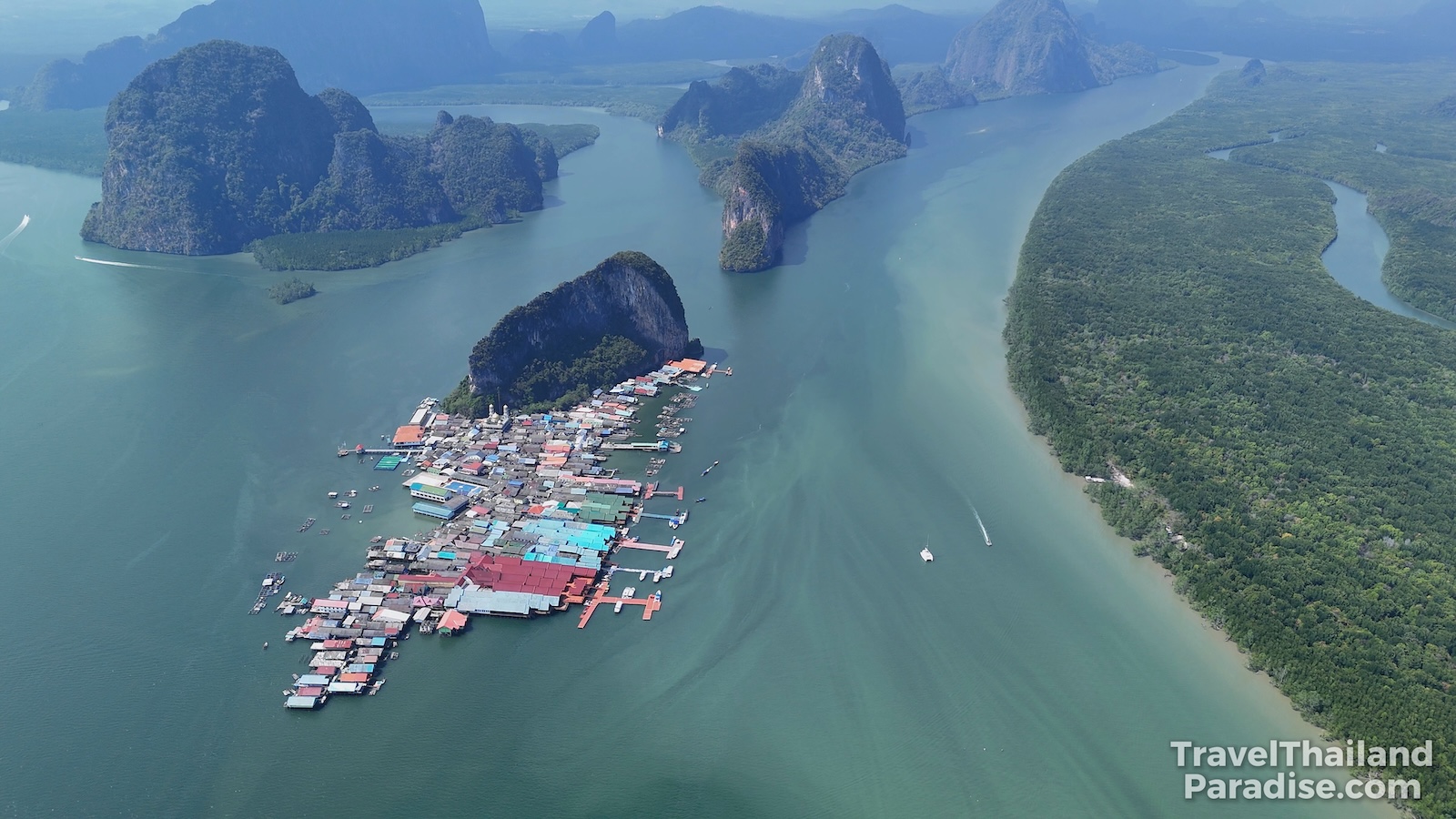
Before we dive into the history, restaurants, floating football field, and practical travel tips, it’s worth understanding why Koh Panyee leaves such a lasting impression on so many visitors.
Planning a visit to Koh Panyee Floating Village? Most travelers arrive expecting nothing more than a quick lunch stop.
After all, nearly every Phang Nga Bay tour follows the same routine. Visit James Bond Island. Take a few photos. Cruise through the limestone cliffs. Stop at Koh Panyee for lunch. Spend thirty or forty minutes walking around before heading back to Phuket or Krabi.
At first glance, it feels like just another stop along the itinerary.
But the moment your longtail boat slowly approaches the village, that impression begins to change.
Instead of seeing a handful of wooden houses floating on the water, an entire community gradually comes into view. Hundreds of homes stand on wooden stilts above the sea, connected by a maze of narrow walkways stretching beneath towering limestone cliffs. Fishing boats gently rock beside family homes, children ride bicycles along wooden platforms, restaurant owners prepare fresh seafood for the day’s visitors, and the call to prayer echoes from the village mosque.
This isn’t a floating attraction built for tourists.
It’s a living community.
Known throughout Thailand as one of the country’s most famous floating Muslim villages, Koh Panyee has been home to generations of fishermen and their families for well over two centuries. Long before speedboats filled Phang Nga Bay with day-trippers, people here had already built an extraordinary way of life almost entirely above the water.
That’s what makes visiting Koh Panyee different from many other attractions in southern Thailand.
You aren’t simply walking through another market or sightseeing destination.
You’re stepping into a village where people still live, work, attend school, pray at the local mosque, repair fishing boats, and raise their children much as they have for generations.
Having the opportunity to see the village from above also changes your perspective completely.
From ground level, Koh Panyee feels like a maze of narrow wooden streets lined with restaurants, souvenir shops, and family homes. But from the air, the entire layout suddenly makes sense. The tightly packed buildings appear to float beneath dramatic limestone cliffs, colorful fishing boats dot the surrounding waters, and the famous floating football field becomes just one small part of an incredibly unique landscape.
It’s a view that few visitors ever experience.
While most travelers only spend enough time here for lunch before continuing to the next island, slowing down—even for another hour—reveals a very different side of Koh Panyee. Walk beyond the busiest restaurants, explore the quieter residential walkways, watch local fishermen preparing their boats, and you’ll quickly realize why this floating village has become one of the most fascinating cultural destinations in Phang Nga Bay.
Whether you’re joining a day trip from Phuket, departing from Krabi, or planning a private longtail boat tour, this Koh Panyee Floating Village Travel Guide covers everything you need to know before visiting—from its remarkable history and local culture to the famous floating football field, the best time to visit, nearby attractions, practical travel tips, and whether Koh Panyee truly deserves a place on your Thailand itinerary.
Quick Navigation
Quick Facts About Koh Panyee Floating Village
- Location: Phang Nga Bay, Phang Nga Province, Thailand
- Type: Traditional floating Muslim fishing village built on wooden stilts
- Founded: More than 200 years ago by Indonesian Muslim fishermen
- Population: Approximately 1,500–2,000 residents
- Known For: Floating football field, fresh seafood restaurants, stilt houses, and dramatic limestone cliffs
- Best Time to Visit: November to April during Thailand’s dry season
- Typical Visit Duration: 1–3 hours (most organized tours stay around one hour)
- Nearest Attractions: James Bond Island, Hong Island, Panak Island, Bat Cave, Ice Cream Cave, and the limestone karsts of Phang Nga Bay
- How to Get There: Longtail boat or speedboat from Phuket, Krabi, or Phang Nga
- Can You Stay Overnight? Yes, although most visitors come on day tours.
| Good to Know | Information |
|---|---|
| Time Needed | 2–3 hours |
| Entrance Fee | Included in most tours |
| Good for Families | ✅ Yes |
| Swimming | ❌ No |
| Restaurants | ✅ Many |
| Overnight Stay | ✅ Possible |
| Wheelchair Friendly | Limited |
| Drone Flying | Subject to Thailand’s drone regulations. Koh Panyee itself is not inside the national park, so a separate National Park drone permit is not required. Always comply with current CAAT rules and obtain any permissions required for your specific flight. |
The Story Behind Thailand’s Famous Floating Village
Most visitors know Koh Panyee simply as the place where their tour stops for lunch.
Few realize they’re walking through one of Thailand’s oldest continuously inhabited floating communities.
Long before tourism transformed Phang Nga Bay into one of southern Thailand’s most visited destinations, Koh Panyee was already home to generations of fishermen who built an extraordinary life almost entirely above the sea.
According to local history, the village was founded more than two centuries ago by Indonesian Muslim fishermen searching for sheltered waters rich in marine life. Protected by the towering limestone cliffs surrounding the bay, they discovered an ideal location where fishing was plentiful and storms were less severe than in the open Andaman Sea.
At the time, local customs prevented non-Thai settlers from owning land. Rather than abandoning the area, the fishermen adapted in an ingenious way—they built their homes over the water instead. Wooden stilts were driven deep into the seabed, creating simple houses connected by narrow walkways.
As families grew, so did the village. One home became several. Walkways expanded. Small shops appeared. A mosque was built at the heart of the community, followed by a school, restaurants, workshops, and eventually everything needed to support everyday life.
Today, that same spirit of adaptation still defines Koh Panyee.
Although tourism has become an important source of income, fishing remains part of daily life for many families. You’ll still see longtail boats tied beside homes, fishermen repairing nets, and locals transporting supplies through the maze of wooden walkways. Children walk to school across platforms built above the sea, while the village mosque continues to serve as the spiritual center of this close-knit Muslim community.
What makes Koh Panyee especially fascinating isn’t simply that the buildings stand on stilts.
It’s that this is not a reconstructed cultural attraction or an open-air museum designed for visitors. People aren’t dressing up for demonstrations or recreating traditions for photographs. Families genuinely live here, businesses operate here, children grow up here, and daily life continues whether tourists are present or not.
That authenticity is something many visitors don’t fully appreciate during a brief stop.
From the moment your boat leaves, the restaurants become quieter, local residents return to their routines, fishing boats head back onto the water, and Koh Panyee once again feels less like a tourist destination and more like the remarkable floating village it has always been.
Arriving at Koh Panyee: The First View You’ll Never Forget

Every destination has a moment when your expectations meet reality.
For Koh Panyee, that moment happens long before you step onto one of its wooden walkways.
Whether you’re arriving on a speedboat from Phuket, a longtail boat from Phang Nga, or as part of a James Bond Island tour, the approach to the village is part of the experience itself. As your boat glides through the calm waters of Phang Nga Bay, the scenery begins to change. Towering limestone karsts rise dramatically from the emerald-green sea, creating one of Thailand’s most recognizable landscapes. Around every turn, another massive cliff seems to appear, making the journey feel almost cinematic.
Then, almost unexpectedly, Koh Panyee comes into view.
From a distance, it doesn’t immediately look like a village. Instead, it appears as a dense collection of colorful rooftops stretching across the water beneath an enormous limestone cliff. As your boat gets closer, individual homes, restaurants, fishing boats, and wooden platforms begin to take shape. It’s difficult not to wonder how an entire community was able to build a functioning village in a place where there was virtually no land to begin with.
Seeing Koh Panyee from above makes that first impression even more remarkable.
From the air, the village reveals a completely different perspective. Hundreds of buildings stand tightly packed together on wooden stilts, surrounded by fishing boats and framed by towering cliffs that seem to protect the community from every direction. The famous floating football field, the mosque, the narrow walkways, and the maze of homes all become visible at once, creating a scene that most visitors never get to experience.
It’s one of those rare places where a drone doesn’t simply provide a better view—it helps explain the destination itself.
Looking down from above, you begin to appreciate just how much engineering, determination, and community effort went into building Koh Panyee over generations. Every section of the village connects seamlessly with another, creating what is essentially a small town floating above the sea.
As your boat slowly approaches the main pier, the atmosphere becomes livelier. Longtail boats unload fresh supplies, tour boats arrive carrying visitors from across the world, and restaurant staff wait to welcome guests stopping for lunch. Despite the increase in tourism over the years, the village still feels surprisingly authentic. Rather than entering a purpose-built attraction, you’re arriving in a place where everyday life continues around you.
That first glimpse often becomes one of the most memorable parts of the entire visit.
Even after walking through the village, exploring the football field, and enjoying lunch overlooking Phang Nga Bay, many travelers find themselves looking back one last time as their boat pulls away. From the water, Koh Panyee once again blends into the limestone landscape, almost disappearing beneath the towering cliffs until it’s little more than a cluster of rooftops in the distance.
It’s a view that’s difficult to forget—and one that often leaves visitors realizing they experienced something far more unique than just another stop on a sightseeing tour.
Walking Through Koh Panyee: More Than Just a Lunch Stop
For many visitors, the first few minutes in Koh Panyee can feel surprisingly familiar.
The main walkway leading from the pier is lined with seafood restaurants, souvenir stalls, clothing shops, and vendors selling everything from handmade crafts to fresh coconuts. Since most organized tours stop here around lunchtime, this part of the village is usually the busiest, with groups moving from restaurant to restaurant before continuing their journey through Phang Nga Bay.
If you only stay in this area, it’s easy to assume you’ve seen everything.
But that’s where many visitors make their first mistake.
Take just a few minutes to continue walking beyond the busiest restaurants, and Koh Panyee begins to reveal a completely different personality.
The souvenir shops gradually become family homes. Wooden decks replace restaurant terraces, and the crowds become noticeably thinner. Instead of hearing tour guides speaking through microphones, you’ll notice everyday sounds that remind you this is still a living community—children laughing as they ride bicycles along narrow walkways, neighbors chatting from one house to another, and fishing boats gently knocking against the wooden stilts beneath the village.
One of the things that surprised me most was how normal daily life feels despite the extraordinary setting.
It’s easy to focus on the fact that everything stands above the water, but after a few minutes, that almost becomes secondary. Residents go about their routines much like they would anywhere else. People sweep in front of their homes, deliveries arrive throughout the day, restaurant owners prepare fresh seafood, and families gather in shaded areas to escape the afternoon heat.
Walking through Koh Panyee also gives you a better appreciation for how cleverly the village has been designed over the years.
The network of wooden walkways connects nearly every corner of the community, allowing residents to move easily between homes, schools, shops, restaurants, and the mosque without ever needing roads or cars. Although the village has expanded significantly since it was first established, it still feels remarkably connected, with each section naturally flowing into the next.
As you continue exploring, you’ll occasionally come across small viewing points where the wooden platforms open toward the sea. From here, colorful longtail boats float against the backdrop of Phang Nga Bay’s towering limestone cliffs, creating some of the most photogenic scenes in the entire village. These quieter corners are a welcome contrast to the busier restaurant area and offer a chance to simply pause and take in the surroundings.
If your schedule allows, don’t rush.
Most tour groups spend less than an hour walking through Koh Panyee before heading back to their boats. Adding even another thirty minutes can completely change your experience. It gives you time to wander beyond the main tourist route, notice the details that many people miss, and appreciate that this isn’t simply a destination built for visitors—it’s a place that continues to thrive as one of Thailand’s most remarkable floating communities.
The Incredible Story Behind Koh Panyee’s Floating Football Field
Of all the places you’ll discover while exploring Koh Panyee, none has become more famous than the village’s floating football field.
At first glance, it almost seems out of place.
Surrounded by fishing boats and traditional wooden houses, you’ll suddenly come across a football pitch built above the water. It’s colorful, compact, and unlike any field most visitors have ever seen. For many travelers, it’s one of the highlights of the entire village, and it’s almost impossible not to stop for a closer look.
What makes it truly special, however, isn’t the floating platform itself.
It’s the story behind it.
Back in the 1980s, football had become increasingly popular among the children of Koh Panyee. Like kids almost everywhere else in the world, they dreamed of playing the game whenever they had free time. The problem was obvious—there was virtually no open land anywhere in the village.
Instead of giving up, they found a solution.
Using old wood, discarded fishing rafts, and whatever materials they could gather, local children built a small floating platform where they could kick a ball around after school. It wasn’t perfect. The surface shifted slightly with the movement of the water, balls regularly ended up in the sea, and players quickly learned that diving after a loose ball was simply part of the game.

What began as a simple idea eventually became something much bigger.
Over the years, football became deeply woven into the identity of the village. Koh Panyee developed youth teams, improved its facilities, and earned recognition across Thailand for producing talented young players despite practicing in conditions unlike anywhere else in the country. Today, the floating football field has become a symbol of determination, creativity, and community spirit rather than just an unusual sports ground.
Standing beside it, it’s easy to understand why so many visitors find the story inspiring.
The field represents far more than an interesting photo opportunity. It reflects the mindset that has shaped Koh Panyee from the very beginning. When the village needed homes, its founders built them above the sea. When children wanted a place to play football, they built that above the sea as well.
That same ability to adapt is visible throughout the entire community.
Even today, you’ll often see local children using the field while visitors watch from the surrounding walkways. Their laughter, friendly matches, and endless energy remind you that this isn’t a monument preserved for tourism. It’s still part of everyday village life, continuing the tradition started decades ago by children who simply wanted a place to play.
By the time you leave the football field, you’ll probably realize that it’s not the floating platform you’ll remember most.
It’s the story behind it—and the reminder that some of the world’s most remarkable places are defined not by luxury or size, but by the ingenuity of the people who call them home.
Where to Eat in Koh Panyee: Fresh Seafood and Local Halal Cuisine
If you’ve booked a day tour to Phang Nga Bay, chances are you’ll be having lunch in Koh Panyee.
In fact, for many visitors, it’s the first time they experience authentic southern Thai cuisine while sitting just a few meters above the sea. Nearly every tour operator includes a meal at one of the village’s waterfront restaurants, making lunch almost as much a part of the Koh Panyee experience as walking through the village itself.
Because Koh Panyee is a traditional Muslim community, all of the restaurants serve halal food, something that surprises many first-time visitors who are unfamiliar with the village’s history. Rather than limiting your choices, however, you’ll still find an excellent variety of Thai dishes, freshly caught seafood, grilled meats, stir-fries, curries, soups, and vegetarian options.
Seafood naturally takes center stage.
Depending on the season, restaurant menus often include prawns, squid, fish, crab, mussels, and other local catches brought in by fishermen from the surrounding waters of Phang Nga Bay. While organized tours usually provide buffet-style meals with several popular Thai dishes, visitors arriving independently can order directly from the menu and enjoy a much more relaxed dining experience.
One of the nicest parts about eating here isn’t necessarily the food itself.
It’s the setting.
Many restaurants are built on wide wooden platforms overlooking the bay, allowing you to enjoy lunch while watching longtail boats drift past the village. Massive limestone cliffs rise in the background, creating scenery that’s difficult to match anywhere else in southern Thailand. Even after the meal is finished, it’s worth lingering for a few extra minutes simply to take in the atmosphere before continuing your walk through the village.
If you’re traveling independently rather than on a guided tour, consider exploring a little before choosing where to eat.
The restaurants closest to the main pier naturally receive the largest tour groups, especially around midday. Walking just a little farther into the village often leads to quieter dining areas where the pace feels more relaxed. Service is usually less rushed, and you’ll have more time to appreciate both the food and the unique surroundings.
While Koh Panyee isn’t necessarily a destination people visit solely for its restaurants, sharing a meal here becomes part of the overall experience.
It’s another reminder that this isn’t a purpose-built tourist attraction. These restaurants serve both visitors and local residents, many of whom have lived in the village for generations. As you enjoy fresh seafood overlooking the calm waters of Phang Nga Bay, it’s easy to imagine how closely everyday life in Koh Panyee has always been connected to the sea.
Whether you’re stopping for a quick buffet lunch as part of an island-hopping tour or sitting down for a leisurely seafood meal before continuing your journey, dining in Koh Panyee adds another layer to the visit—one that combines local flavors, cultural traditions, and one of the most unforgettable waterfront settings in Thailand.
Common Mistakes Visitors Make at Koh Panyee
Most people leave Koh Panyee with positive memories.
The dramatic scenery, unique floating village, and fresh seafood make it one of the most memorable stops in Phang Nga Bay. Yet many visitors also leave feeling as though they only experienced a small part of what the village has to offer.
In most cases, that’s not because Koh Panyee isn’t interesting.
It’s because they unknowingly make a few common mistakes.
The biggest one is treating the village as nothing more than a lunch stop.
Many organized tours follow a tight schedule, giving visitors just enough time to eat, browse a few souvenir shops, and walk along the main street before heading back to the boat. While that’s enough to get a quick impression, it barely scratches the surface of what makes Koh Panyee unique. If you have the opportunity, spend a little extra time wandering beyond the busiest areas. The quieter residential walkways often provide a much better sense of everyday life than the crowded restaurant district.
Another mistake is expecting Koh Panyee to feel like a traditional Thai island.
Despite the name beginning with “Koh,” which means island, this isn’t the kind of destination where you’ll find sandy beaches, beach bars, or places to swim. Koh Panyee is a floating village built almost entirely on wooden stilts, and its appeal comes from its culture, history, and remarkable location rather than classic tropical beach activities.
Some visitors also overlook the importance of being respectful while exploring.
Although tourism plays a significant role in the local economy, Koh Panyee remains a working community where families live their daily lives. You’ll pass homes, schools, and the village mosque as you walk through the narrow pathways. Speaking quietly in residential areas, asking permission before taking close-up photographs of people, and dressing respectfully are small gestures that help preserve the welcoming atmosphere the village is known for.
Timing is another factor many travelers underestimate.
The busiest hours are usually around lunchtime, when dozens of tour boats arrive almost simultaneously. Restaurants become crowded, the main walkways fill with visitors, and the village feels noticeably busier. If you’re visiting independently, arriving slightly earlier or later can make the experience feel much more relaxed and give you better opportunities for photography.
Finally, don’t forget to look up.
It’s easy to focus on the restaurants, souvenir stalls, and bustling walkways directly in front of you. But every so often, pause for a moment and take in the towering limestone cliffs surrounding the village. They are just as much a part of Koh Panyee’s identity as the floating houses themselves, creating the dramatic natural backdrop that has protected this community for generations.
Avoiding these simple mistakes won’t completely change your visit—but it will almost certainly help you appreciate Koh Panyee for what it truly is: not simply another stop on a tour itinerary, but one of Thailand’s most fascinating and resilient communities.
Nearby Attractions Worth Visiting After Koh Panyee
One of the biggest advantages of visiting Koh Panyee is that it’s rarely the only destination on your itinerary.
Located in the heart of Phang Nga Bay, the floating village sits among dozens of limestone islands, hidden lagoons, and dramatic sea caves that have made this part of southern Thailand famous around the world. Whether you’re joining an organized speedboat tour or hiring a private longtail boat, Koh Panyee is usually combined with several other incredible attractions, allowing you to experience far more than just the village itself.
The most famous stop is undoubtedly James Bond Island, located only a short boat ride away. Officially known as Khao Phing Kan, the island became internationally famous after appearing in the 1974 James Bond movie The Man with the Golden Gun. Today, visitors come to admire its iconic limestone sea stack rising dramatically from the water, making it one of Thailand’s most photographed landmarks. While James Bond Island delivers spectacular scenery, Koh Panyee offers something completely different—a chance to experience local culture and everyday life within a community that has existed for generations.
Another destination that shouldn’t be missed is Hong Island in Phang Nga Bay. Unlike the better-known Hong Island in Krabi, this hidden lagoon is reached by passing through a narrow opening in the limestone cliffs. Once inside, you’ll find a peaceful enclosed lagoon surrounded by towering rock walls covered in tropical vegetation. The calm water and quiet atmosphere create a striking contrast to the livelier surroundings of Koh Panyee.
Nature lovers will also appreciate visiting Panak Island, famous for its sea caves, mangrove forests, and hidden lagoons that can often be explored by kayak. Depending on the tide, paddling through narrow cave entrances opens up secret chambers where towering cliffs completely surround you, making it feel as though you’ve entered another world hidden within the island itself.
Many tours also include stops at smaller limestone formations, sea caves, and secluded bays scattered throughout Phang Nga Bay. While some are little more than brief sightseeing stops, others offer opportunities to kayak beneath towering cliffs, discover hidden beaches, or simply enjoy the breathtaking scenery that makes this region one of Thailand’s natural treasures.
Together, these destinations create an experience that’s remarkably diverse.
In a single day, you can walk through a centuries-old floating Muslim village, photograph one of Thailand’s most famous landmarks, paddle into hidden lagoons, cruise beneath towering limestone cliffs, and enjoy fresh seafood overlooking the Andaman Sea. Very few day trips in Thailand combine cultural history, dramatic landscapes, and unforgettable scenery as successfully as a journey through Phang Nga Bay.
Although Koh Panyee is often remembered as the place where visitors stop for lunch, it also serves as the cultural heart of many Phang Nga Bay tours. Combined with the surrounding islands and lagoons, it helps transform an ordinary sightseeing trip into one of the most memorable adventures in southern Thailand.
Best Time to Visit Koh Panyee Floating Village
Like most destinations in southern Thailand, Koh Panyee can be visited throughout the year.
The experience, however, changes depending on the season, the weather, and even the time of day you arrive.
For most travelers, the best months to visit are between November and April, when the Andaman coast enters its dry season. During this period, Phang Nga Bay usually enjoys calmer seas, blue skies, and excellent visibility, making boat journeys smoother and allowing the dramatic limestone cliffs surrounding Koh Panyee to stand out against bright tropical skies. It’s also the ideal time for photography, whether you’re capturing the village from the water or watching it from above with a drone.
That doesn’t mean the rainy season should automatically be avoided.
From May through October, brief tropical showers become more common, but they rarely last all day. In fact, some visitors enjoy this time of year because the surrounding cliffs and mangrove forests appear even greener after rainfall, while the occasional mist drifting between the limestone formations creates an entirely different atmosphere. Boat schedules may be adjusted if weather conditions become rough, but on many days tours continue as normal.
Another factor worth considering is the time of day.
Most organized tours arrive around lunchtime, often between late morning and early afternoon. During these hours, several speedboats and longtail boats can reach the village within a short period, making the restaurants, souvenir shops, and main walkways noticeably busier. If you’re traveling independently or arranging a private boat, arriving a little earlier in the morning or later in the afternoon often provides a quieter experience and makes it easier to explore at your own pace.
The changing tide also plays a subtle role in how Koh Panyee looks.
At high tide, the village appears to float effortlessly above the water, with boats tied directly alongside the wooden platforms. During lower tides, more of the supporting stilts become visible, offering a different perspective on how this remarkable community has been built and maintained over generations. Neither is necessarily better—they simply reveal different sides of village life.
If you’re hoping to capture the best photographs or videos, soft morning light generally produces the most balanced conditions. The limestone cliffs, colorful fishing boats, and wooden houses are beautifully illuminated, while the calmer atmosphere before the busiest tour groups arrive allows for more relaxed exploration. Late afternoon can also be rewarding, particularly as the warm sunlight begins to reflect across the calm waters of Phang Nga Bay.
Ultimately, there is no bad time to visit Koh Panyee.
Each season offers a slightly different experience, and every visit depends on the weather, tides, and number of tour boats arriving that day. Whether you explore beneath bright blue skies in January or beneath dramatic clouds during the green season, the village’s unique character remains unchanged. It’s this combination of history, culture, and spectacular natural surroundings that continues to make Koh Panyee one of the most fascinating destinations in southern Thailand.
Frequently Asked Questions About Koh Panyee Floating Village
How much time do you need at Koh Panyee?
Most organized tours spend between 45 minutes and 1½ hours at Koh Panyee, usually including lunch. While that’s enough to see the main attractions, visitors traveling independently may want to allow 2 to 3 hours. This gives you plenty of time to walk beyond the busiest restaurants, visit the floating football field, enjoy a relaxed meal, browse the local shops, and experience more of the village at your own pace.
Can you stay overnight at Koh Panyee?
Yes. Although the vast majority of visitors arrive on day trips, a small number of guesthouses and homestays allow travelers to spend the night in the village. Staying overnight offers a completely different experience, with peaceful evenings, quiet early mornings, and an opportunity to see Koh Panyee after the tour boats have departed. Accommodation options are limited, so it’s worth planning ahead if an overnight stay interests you.
Is Koh Panyee suitable for families with children?
Absolutely.
Families often enjoy Koh Panyee because the village is easy to explore on foot, the floating football field is fascinating for children, and boat rides through Phang Nga Bay are an adventure in themselves. Parents should simply keep an eye on younger children near the edges of some wooden walkways, particularly where there are no guardrails overlooking the water.
Do you need to join a tour to visit Koh Panyee?
No.
While most visitors arrive as part of organized tours from Phuket, Krabi, or Phang Nga, it’s also possible to hire a private longtail boat or arrange a customized day trip. Independent travel gives you greater flexibility, allowing you to spend more time exploring the village and avoid the busiest arrival times when multiple tour boats reach Koh Panyee together.
Is Koh Panyee only famous for its floating football field?
Not at all.
Although the floating football field has become one of Koh Panyee’s most recognizable landmarks, the village offers much more than a unique sports pitch. Its centuries-old history, traditional Muslim community, seafood restaurants, dramatic limestone scenery, and remarkable stilt houses are equally important parts of the experience. For many visitors, simply wandering through the village and observing everyday life becomes the highlight of the trip.
Is Koh Panyee worth visiting if you’re already going to James Bond Island?
Definitely.
While the two destinations are often included on the same tour, they offer completely different experiences. James Bond Island is famous for its spectacular limestone formations and movie history, whereas Koh Panyee provides a chance to experience local culture, learn about one of Thailand’s most unique communities, and enjoy a meal in an unforgettable setting. Together, they complement each other exceptionally well and create one of the most rewarding day trips in Phang Nga Bay.
Final Thoughts: Is Koh Panyee Floating Village Worth Visiting?
After visiting Koh Panyee, it’s easy to understand why opinions about the village can be surprisingly mixed.
Ask someone who only stopped for a rushed buffet lunch before quickly boarding their speedboat again, and they might tell you it’s an interesting place but not necessarily the highlight of their trip.
Ask someone who took the time to wander beyond the restaurants, explore the quieter walkways, watch local life unfold, and appreciate the remarkable history behind this floating community, and you’ll probably hear a very different answer.
The truth is, both experiences are real.
Koh Panyee can be a quick stop on a busy tour itinerary, or it can become one of the most memorable places you visit in southern Thailand. The difference often comes down to how much time you’re willing to give it.
Unlike many destinations in Thailand that attract visitors because of white sandy beaches or crystal-clear water, Koh Panyee offers something entirely different. It invites you to experience a way of life that has adapted to the sea for generations. Every wooden walkway, every family home standing on stilts, every fishing boat tied beneath a house, and every smiling child riding a bicycle through the village tells part of a story that began more than two hundred years ago.
That’s what stayed with me the most.
Of course, the scenery is spectacular. The towering limestone cliffs surrounding the village create one of the most dramatic settings anywhere in Phang Nga Bay, and seeing Koh Panyee from above offers a perspective that few visitors ever experience. But once the drone lands and the camera is put away, it’s the atmosphere of the village itself that leaves the stronger impression.
Watching daily life continue around you makes it easy to forget you’re standing in one of Thailand’s most visited tourist destinations.
People aren’t here to perform for visitors. They’re opening their restaurants, repairing boats, walking home from school, chatting with neighbors, and going about their day exactly as they would whether tourists were present or not. That authenticity is becoming increasingly rare, especially in destinations that have become popular around the world.
If you’re planning a trip through Phang Nga Bay, my advice is simple.
Don’t think of Koh Panyee as the place where your tour stops for lunch.
Think of it as one of the few opportunities to step inside a living floating village that continues to preserve its traditions while welcoming visitors from every corner of the world. Slow down, wander beyond the busiest streets, take in the views over the bay, and allow yourself a little more time than the average tour schedule suggests.
You may arrive expecting nothing more than another stop between James Bond Island and the next limestone lagoon.
There’s a good chance you’ll leave remembering Koh Panyee more than either of them.
For official updates, visa requirements, you can also check the Tourism Authority of Thailand website.


