Quick Navigation
What to know about Lamai Beach
- Lamai Beach Koh Samui Thailand is a wide, open beach with soft golden sand and fewer crowds than other parts of the island
- Calm, swimmable water that feels inviting at any time of day
- A perfect balance between relaxation, local culture, and just enough nightlife
- Easy access to waterfalls, temples, viewpoints, and hidden corners of the island
- A destination that feels more personal, more authentic, and far less rushed
There’s something about arriving at Lamai Beach that feels different from the rest of Koh Samui. It doesn’t hit you all at once.
There’s no dramatic entrance, no sudden explosion of noise or activity. Instead, the transition happens gradually. The road begins to open up, the buildings become more spaced out, and the air shifts—warmer, softer, carrying that unmistakable scent of salt and tropical heat.
Palm trees start to appear more frequently, leaning slightly as if shaped by years of ocean wind. Small cafés, massage huts, and low-rise resorts line the road, but nothing feels crowded or overwhelming. Everything seems to exist with intention, leaving space between each place, allowing the surroundings to breathe.
And then, almost without warning, the ocean appears.
Not just a glimpse—but a full, uninterrupted stretch of coastline.
Wide. Open. Calm.
That first view of Lamai Beach doesn’t overwhelm you—it settles you.
You step out, and instantly, the pace changes.
There’s no urgency here. No pressure to do anything immediately. The sound of the waves is soft, almost rhythmic, and the entire atmosphere feels like it’s inviting you to slow down without even asking.
It’s the kind of place where you don’t feel like a tourist the moment you arrive.
Instead, it feels like you’ve stepped into a version of the island that most people move past too quickly.
And that’s exactly what makes Lamai Beach Koh Samui Thailand so different.
It doesn’t try to impress you. It just lets you experience it.

The First Walk — Where Lamai Beach Starts to Reveal Itself
The first thing you notice when stepping onto Lamai Beach isn’t just how beautiful it is.
It’s how unhurried everything feels.
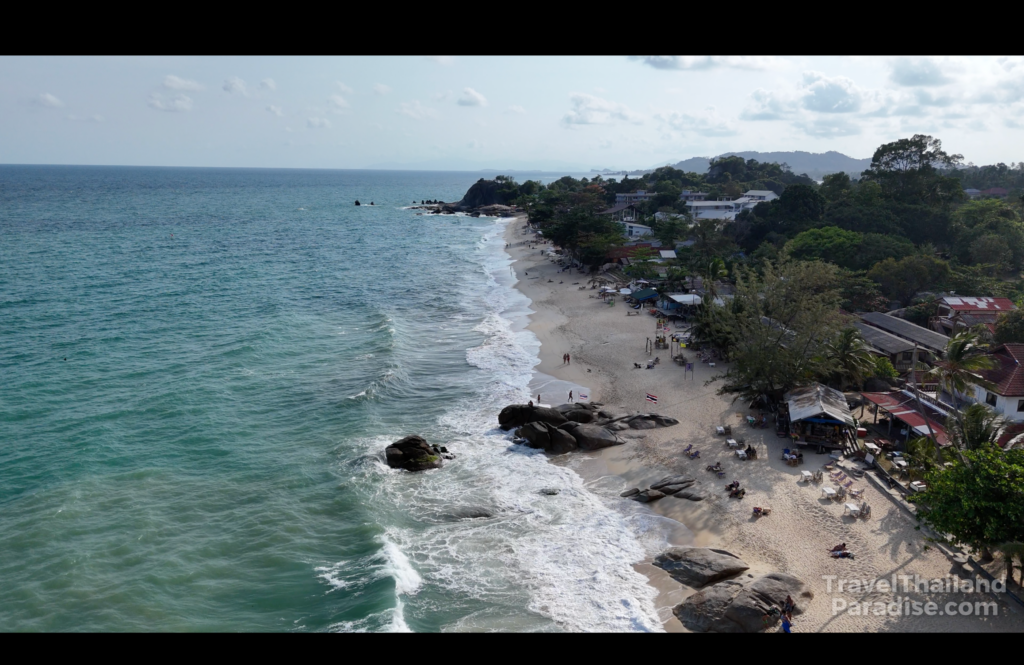
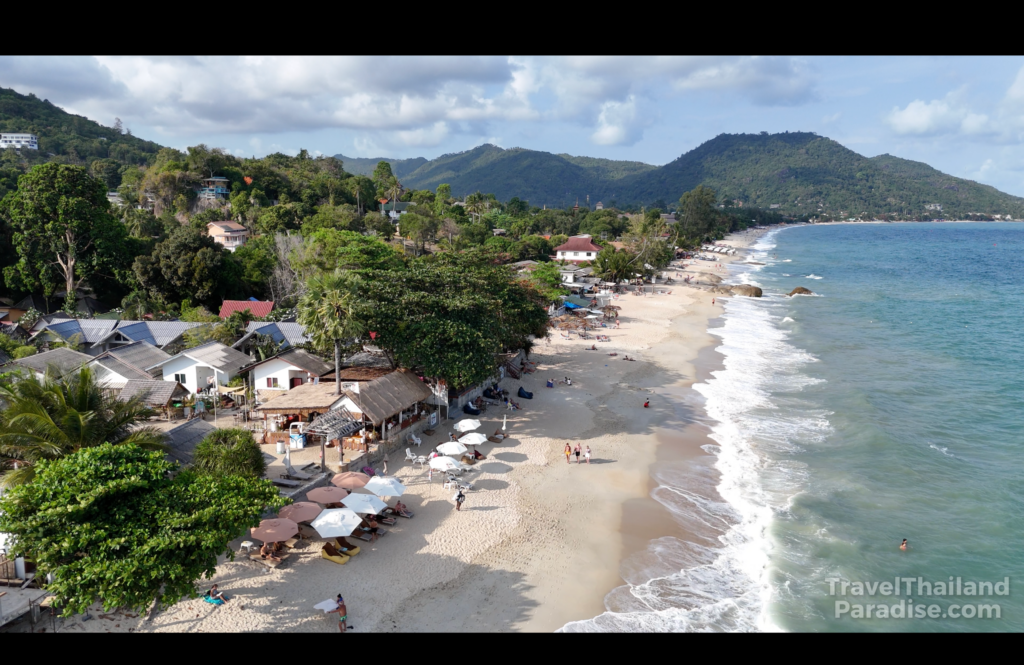
The sand stretches out wide in both directions, soft and slightly warm under your feet, with just enough texture to remind you it hasn’t been overworked or overdesigned. There’s space—real space—not just between you and the water, but between people.
You don’t feel surrounded.
You feel free to move.
And naturally, you start walking.
Not toward anything specific. There’s no landmark pulling you forward, no “must-see” spot forcing direction. You simply walk because the beach invites it.
The shoreline curves gently, guiding you without effort. Small waves roll in and dissolve quietly at your feet, never aggressive, never loud. The water is clear enough to see the sand beneath, shifting slightly as each wave pulls back.
It’s the kind of water you don’t hesitate to step into.
Warm. Calm. Predictable.
You keep moving.
To your left, a few early swimmers float lazily, barely moving, letting the ocean carry them. To your right, someone sits under a palm tree, completely still, watching the horizon as if there’s nowhere else they need to be.
There are no vendors calling out. No constant interruptions. No pressure to buy, to join, to participate.
Just the quiet presence of other people doing exactly what you’re doing—nothing in particular, yet fully present.
As you continue, you start to notice the details that define Lamai.
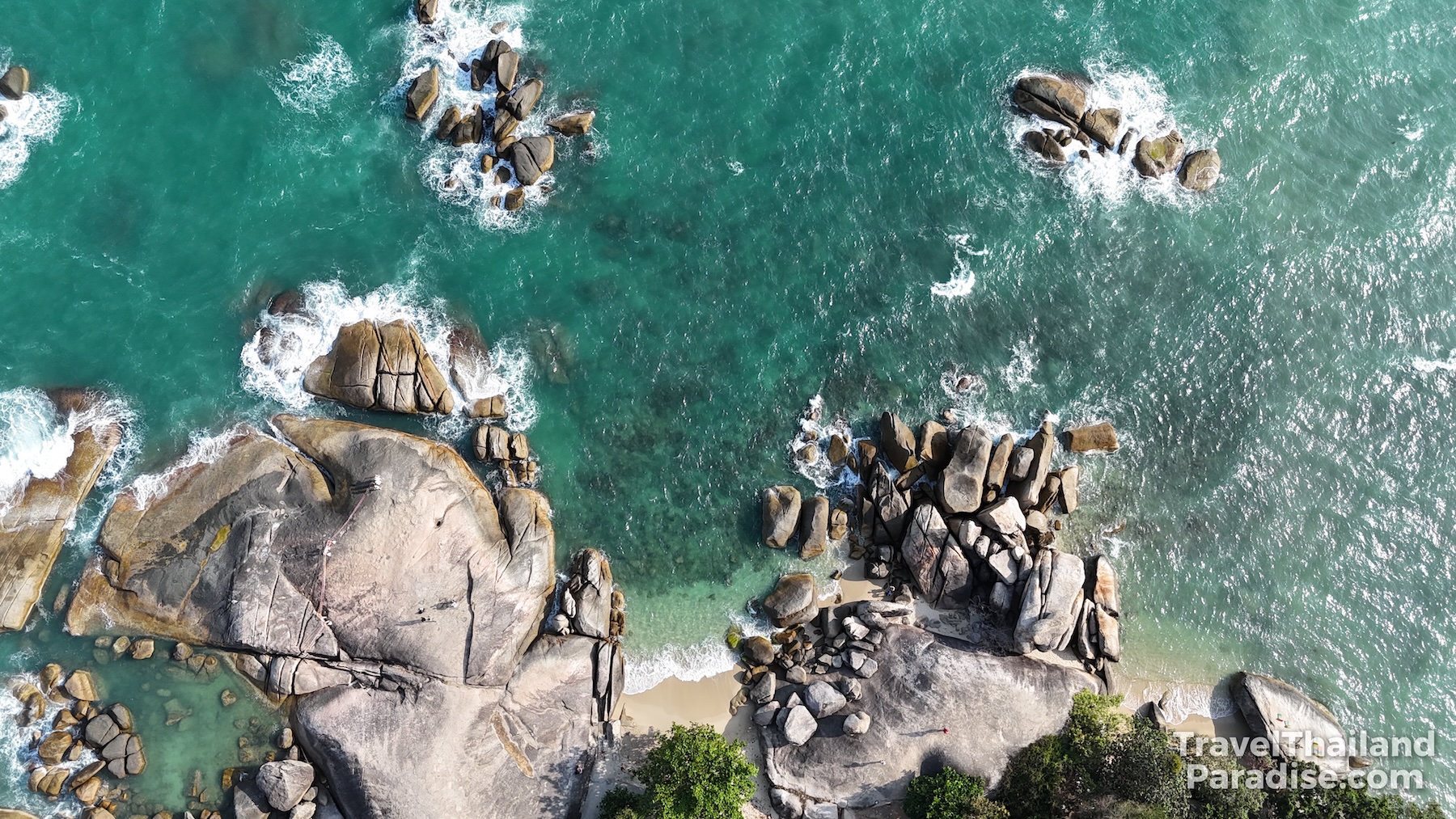
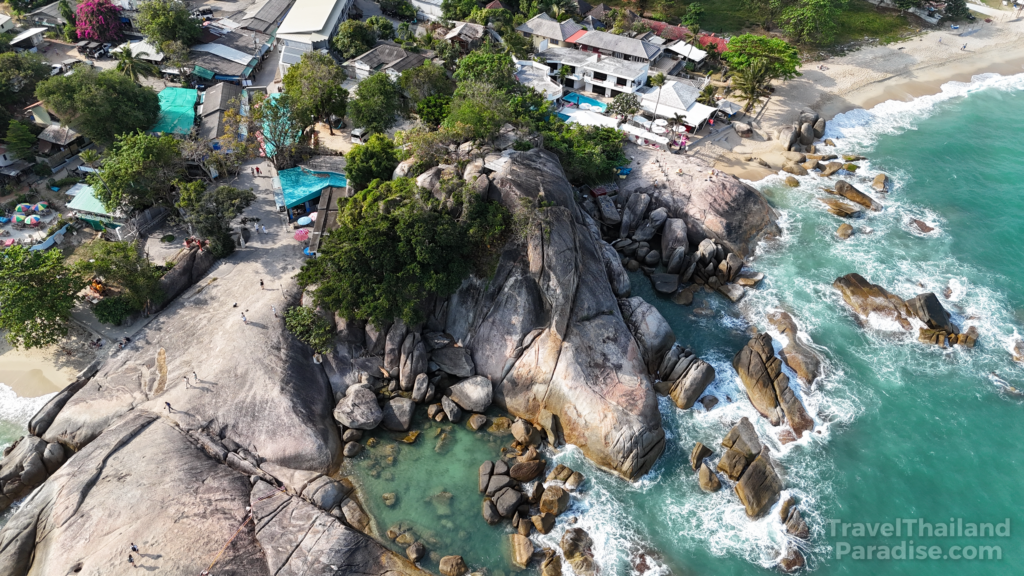
Granite rocks appear along parts of the shoreline, smooth and rounded, shaped over time by wind and water. They don’t dominate the beach, but they give it structure, breaking the long stretch of sand into natural sections.
The palm trees lean differently here—less uniform, more organic. Some stretch toward the sea, others bend slightly inland, casting uneven shadows across the sand that shift as the sun climbs higher.
Everything feels untouched, even though you know it isn’t.
That’s the illusion Lamai creates so well.
It’s developed—but never feels overdeveloped.
After a while, you stop walking.
Not because you’ve reached anything, but because there’s no reason to keep moving.
You step into the water.
The temperature is perfect—not refreshing in a shocking way, but comfortable enough that you don’t think about it. You wade in slowly, feeling the sand shift beneath your feet, adjusting with each movement of the tide.
And for a moment, everything simplifies.
No plans. No schedule. No decisions.
Just the sound of water, the warmth of the sun, and the quiet realization that you don’t need anything else right now.
That’s when Lamai starts to make sense.
Not as a destination.
But as a feeling.
Why Lamai Beach Feels Different From Anywhere Else in Koh Samui
At some point during your stay, you start to notice something subtle. Lamai doesn’t feel like the rest of Koh Samui. And the difference isn’t just about how it looks—it’s about how it moves.
If you’ve spent any time on the island, especially in Chaweng, you immediately understand the contrast. Chaweng is fast, energetic, constantly shifting. Music spills out onto the streets, traffic builds quickly, and everything feels designed to keep you engaged, entertained, and moving.
Lamai takes a completely different approach. Here, nothing is trying to pull you in every direction at once.
The streets are active, but never overwhelming. Restaurants fill gradually instead of all at once. Even the traffic feels slower, more spaced out, as if the entire area has agreed to operate at a more natural rhythm.
You notice it in small ways first.
You can cross the road without feeling rushed. You can sit at a café without being interrupted every few minutes. You can walk along the beach without constantly navigating through dense crowds.
And over time, those small differences start to matter more than anything else. Because they change how you experience the place.
In Lamai, you’re not reacting to your surroundings. You’re moving with them. That’s what creates the balance Lamai is known for.
It has enough energy to keep things interesting—but never so much that it becomes exhausting.
You can spend your morning in complete silence by the water, your afternoon exploring temples or waterfalls, and your evening enjoying a drink by the beach with soft music in the background.
Nothing feels forced. Nothing feels excessive. And that balance makes Lamai incredibly versatile.
Couples find it romantic without trying too hard. Solo travelers feel comfortable without needing constant activity. Even long-term visitors often choose Lamai because it feels livable—not just visitable.
It’s the kind of place where a few days easily turn into a week.
And a week starts to feel too short.
Another thing that sets Lamai apart is how it handles development.
Yes, there are resorts, restaurants, and bars—but they don’t dominate the landscape. Buildings are lower, more spaced out, often surrounded by greenery instead of concrete.
You don’t feel boxed in. You feel connected—to the beach, to the air, to the environment around you. Even at its busiest, Lamai never fully loses that sense of openness. And that’s rare.
Because in many destinations, once popularity increases, space disappears. In Lamai, it hasn’t. Or at least, it hasn’t in the way you would expect.
That’s why people who come here often say the same thing:
It feels like what the island used to be. Not untouched. Not undiscovered. But still authentic enough that you can experience it on your own terms.
And once you get used to that feeling, it becomes very hard to trade it for anything else.
A Full Day at Lamai Beach — From First Light to After Dark
There’s a certain rhythm to Lamai that only reveals itself if you stay long enough to experience a full day from beginning to end.
Not just passing through.
But staying, observing, and letting the day unfold naturally.
Morning — The Quietest Version of Lamai
The day begins slowly.
Before the sun fully rises, the beach feels almost untouched. The air is cooler, lighter, and the sky carries that soft gradient between night and day—deep blue fading into pale gold.
You step onto the sand, and it feels different than later in the day. Smoother. Cooler. Undisturbed.
The ocean is calm, almost perfectly flat, reflecting the sky like a mirror. Small waves move gently, barely breaking, creating a steady, almost meditative sound.
A few people are already there. Some walking. Some stretching. Others simply sitting, facing the horizon without distraction.
There’s no noise from jet skis. No music from bars. No movement from vendors.
Just the natural rhythm of the place. This is Lamai at its most honest.
And for many, it becomes the favorite part of the day.
Late Morning to Afternoon — The Beach Comes to Life
As the sun rises higher, Lamai slowly begins to wake up.
Not abruptly—but gradually.
Cafés open. Sunbeds start filling. The beach becomes more active, but never overwhelming.
This is when the colors become more vivid.
The water shifts into a brighter turquoise. The sand reflects the sunlight, almost glowing. Palm trees cast shorter shadows, and the heat settles in—but not in a way that feels oppressive.
You move between the water and the shade.
Swimming becomes effortless. The sea remains calm, allowing you to stay in for long stretches without thinking about currents or waves.
Between swims, you sit at a beachfront restaurant.
No rush. No pressure to leave.
You order something simple—fresh fruit, grilled seafood, maybe a cold drink—and watch the beach continue its slow transformation.
People arrive. Some leave. Others stay for hours.
Time feels stretched.
Not slow in a boring way—but expanded, as if the day has more space inside it.
Late Afternoon — When Everything Softens Again
By late afternoon, the intensity of the sun begins to fade. The light changes.
Shadows grow longer. The colors warm up. The beach becomes quieter again, not empty, but calmer—like it’s preparing for the transition into evening.
This is when Lamai feels the most balanced.
You can still swim, but the heat is no longer intense. Walking along the shore becomes more comfortable again. The air carries a slight breeze, enough to cool everything just enough.
You start noticing the details again.
The sound of the water becomes more prominent. Conversations from nearby tables blend into the background. The entire environment feels softer.
This is also when many people begin to gather for sunset.
Not in large crowds—but in small, scattered groups, each finding their own spot.
Sunset — The Moment That Brings Everyone Together
Sunset in Lamai isn’t dramatic in the way some places are. It’s subtle.
The sky shifts gradually—gold to orange, orange to soft pink, pink fading into deeper shades as the sun disappears behind the horizon.
The ocean reflects it all.
Everything slows down again.
People stop walking. Conversations pause. Cameras come out, but even that feels quiet, respectful.
For a few minutes, nothing else matters.
And then, just as gently as it arrived, the moment passes.
Night — Relaxed, Social, and Effortless
After dark, Lamai doesn’t transform into chaos. It simply becomes social.
Restaurants fill up, but without long waits or overwhelming noise. Beach bars light up with soft music. Fire shows begin along the shoreline, drawing small crowds that gather, watch, and then drift away again.
You move naturally from one place to another. A drink here. Dinner there. Maybe another stop after.
There’s no pressure to stay out late—but there’s always something happening if you want to.
And that’s what defines Lamai at night. Options—without expectations.
You can end your night early, walking back along the beach with only the sound of the waves. Or you can stay out, meeting people, exploring, letting the night stretch a little longer.
Either way feels right.
Because in Lamai Beach, the day never feels rushed—and neither does the night.
Beyond the Beach — The Cultural Side of Lamai
At first, Lamai feels like it’s all about the beach. And for a while, that’s enough.
But if you stay just a little longer, curiosity naturally pulls you inland—and that’s where another side of Lamai begins to reveal itself.
Not louder.
Not more crowded.
Just deeper.
A few minutes away from the shoreline, the atmosphere shifts completely. The sound of the ocean fades, replaced by stillness, shaded roads, and the occasional echo of temple bells.
At Wat Lamai, the pace slows even further.
The temple grounds feel calm, almost suspended in time. Trees provide shade over open spaces, and the structures themselves carry that distinct Thai architectural style—ornate but not overwhelming, detailed without feeling excessive.
It’s not a place you rush through.
You walk slowly, observing small details—murals, statues, offerings left quietly by locals. There’s also a cultural museum here, often overlooked, that tells the story of how the island evolved over time.
From fishing communities to a global destination. Seeing that transition adds context to everything you’ve experienced so far.
It reminds you that Lamai isn’t just a place designed for visitors. It’s a place that existed long before tourism—and still holds onto parts of that identity.
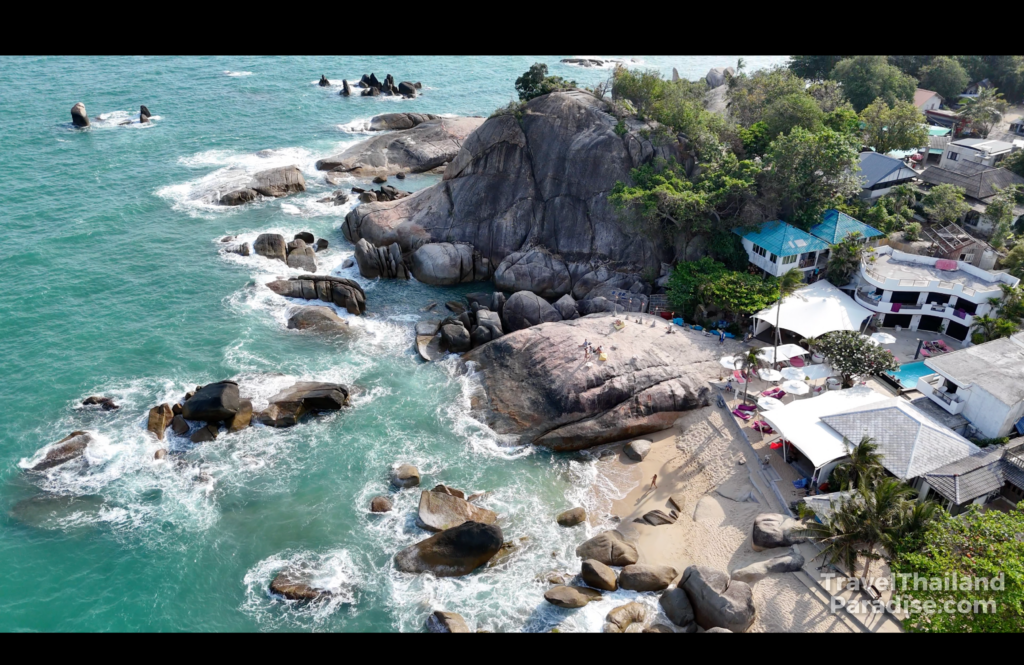
Not far from there, the landscape shifts again. You arrive at Hin Ta and Hin Yai Rocks, one of Lamai’s most talked-about landmarks.
At first glance, they seem simple—natural granite formations shaped by time. But the longer you stand there, the more you understand why they’ve become iconic.
There’s a story behind them. A local legend passed down through generations, adding a layer of meaning that goes beyond what you see.
Whether you come for the folklore or just the view, the location itself feels significant.
The rocks sit at the edge of the coastline, facing open water, exposed to wind and waves. It’s raw, slightly rugged, and completely different from the softer feel of the main beach.
And that contrast matters.
Because it shows another side of Lamai—one that isn’t polished or curated.
Just natural.
If you continue exploring inland, you’ll find even more hidden corners.
Small roads lead into dense greenery, where the island becomes quieter, more untouched. Waterfalls like Na Muang are tucked away in the hills, surrounded by jungle that feels far removed from the coastline.
The air becomes cooler. The sounds change. The entire environment feels more enclosed, more intimate.
It’s easy to forget how close you still are to the beach. And that’s what makes Lamai unique. You’re never limited to one experience.
Within minutes, you can move from open shoreline to cultural landmarks to jungle landscapes—each offering a completely different perspective of the island.
And together, they create something far more complete than just a beach destination.
Living in Lamai — Food, Stay, and the Nights That Stay With You
After a few days in Lamai Beach, something shifts. You stop thinking of it as a place you’re visiting—and start feeling like you’re living inside it.
Meals become part of that experience.
You don’t plan where to eat days in advance. Instead, you discover places as you move. A small roadside restaurant catches your attention. A beachfront table opens up at just the right moment. A night market draws you in with the smell of grilled seafood and spices.
You sit down, often without expectations, and somehow the food always delivers.
Fresh fish, simple Thai dishes, tropical fruit—it all feels more flavorful here, not because it’s complicated, but because it fits the setting perfectly.
Places like The Cliff Bar & Grill offer elevated dining with ocean views, while smaller local spots give you something just as memorable in a completely different way.
Where you stay becomes just as important.
In Lamai Beach, accommodation doesn’t feel separated from the environment. Even larger resorts blend into the landscape, surrounded by greenery instead of concrete. Boutique hotels and beachfront bungalows offer a more personal experience, where mornings begin just steps from the sand.
And for those looking for something more private, places like Banyan Tree Samui provide villas with panoramic views, infinity pools, and complete seclusion.
But no matter where you stay, Lamai never feels overwhelming.
It always feels manageable.
At night, that same balance continues.
The area comes alive—but gently. Beach bars light up with soft music, fire shows flicker along the shoreline, and small groups gather without turning the night into chaos.
Places like Swing Bar Samui create a social atmosphere without pressure. You can stay out, meet people, move between spots—or simply walk along the beach under the sound of the waves.
There’s no right way to end the night here.
And that’s exactly the point.
Why Lamai Beach Koh Samui Thailand Belongs on Your List
By the time you leave Lamai, you realize something important.
It was never about finding the most famous beach. Or the busiest one. It was about finding a place that feels right.
Lamai doesn’t overwhelm you with choices or distractions. It gives you space—to slow down, to explore at your own pace, and to experience the island in a way that feels natural.
And long after you leave Koh Samui, what stays with you isn’t just the view.
It’s the feeling of being there.
For official updates, visa requirements, you can also check the Tourism Authority of Thailand website.


