Quick Navigation
What You’ll Discover In This Guide
- Why Ya Nui Beach feels completely different from most Phuket beaches
- What makes this tiny stretch of sand surprisingly memorable
- Snorkeling, kayaking, and the nearby island everyone notices from shore
- The reality of crowds, parking, and visiting during high season
- How Ya Nui compares to nearby Nai Harn Beach
- The best time of day to visit
- Common mistakes first-time visitors make
- Whether Ya Nui Beach is actually worth adding to your Phuket itinerary
If you’re planning to explore southern Phuket, there’s a good chance you’ll eventually come across a small bay tucked between Windmill Viewpoint and Promthep Cape. At first glance, it doesn’t look particularly famous or impressive compared to some of the island’s larger beaches.
Which naturally leads many travelers to ask: is Ya Nui Beach worth visiting?
The answer isn’t as obvious as you might think.
Ya Nui Beach isn’t Phuket’s largest beach. It isn’t lined with luxury resorts, and it rarely appears in the same conversations as Patong, Kata, or Karon.
Yet this small stretch of sand has quietly become one of the most memorable beaches on the island.
In fact, if you’re driving around this part of Phuket for the first time, there’s a good chance you could miss it completely.
The road curves around the coastline between Windmill Viewpoint and Promthep Cape. One moment you’re looking at dramatic cliffs and open ocean. The next, a tiny bay appears below, tucked between green hills and rocky headlands.
That’s Ya Nui Beach.
First Impressions: A Beach That Feels Almost Hidden
The first thing most visitors notice isn’t the beach itself.
It’s the size.
After seeing massive stretches of sand elsewhere in Phuket, Ya Nui almost feels too small to be considered a major beach at all.
But size is part of the charm.
The bay sits inside a natural cove protected by rocky formations on both sides. The surrounding hills create a sense of enclosure that makes the beach feel private, even when other visitors are around.
The water often appears turquoise near shore before fading into deeper shades of blue farther out.
Directly offshore sits a small island that instantly catches your attention.
You look at it and immediately think:
“I wonder if I can get there.”
As it turns out, you can.
And many people do.
Unlike larger Phuket beaches where jet skis dominate the view and speedboats constantly arrive and depart, Ya Nui feels slower.
More personal.
More connected to the surrounding landscape.
It isn’t trying to entertain you.
It simply exists exactly as it is.
And that’s enough.
The View From Above Changes Everything

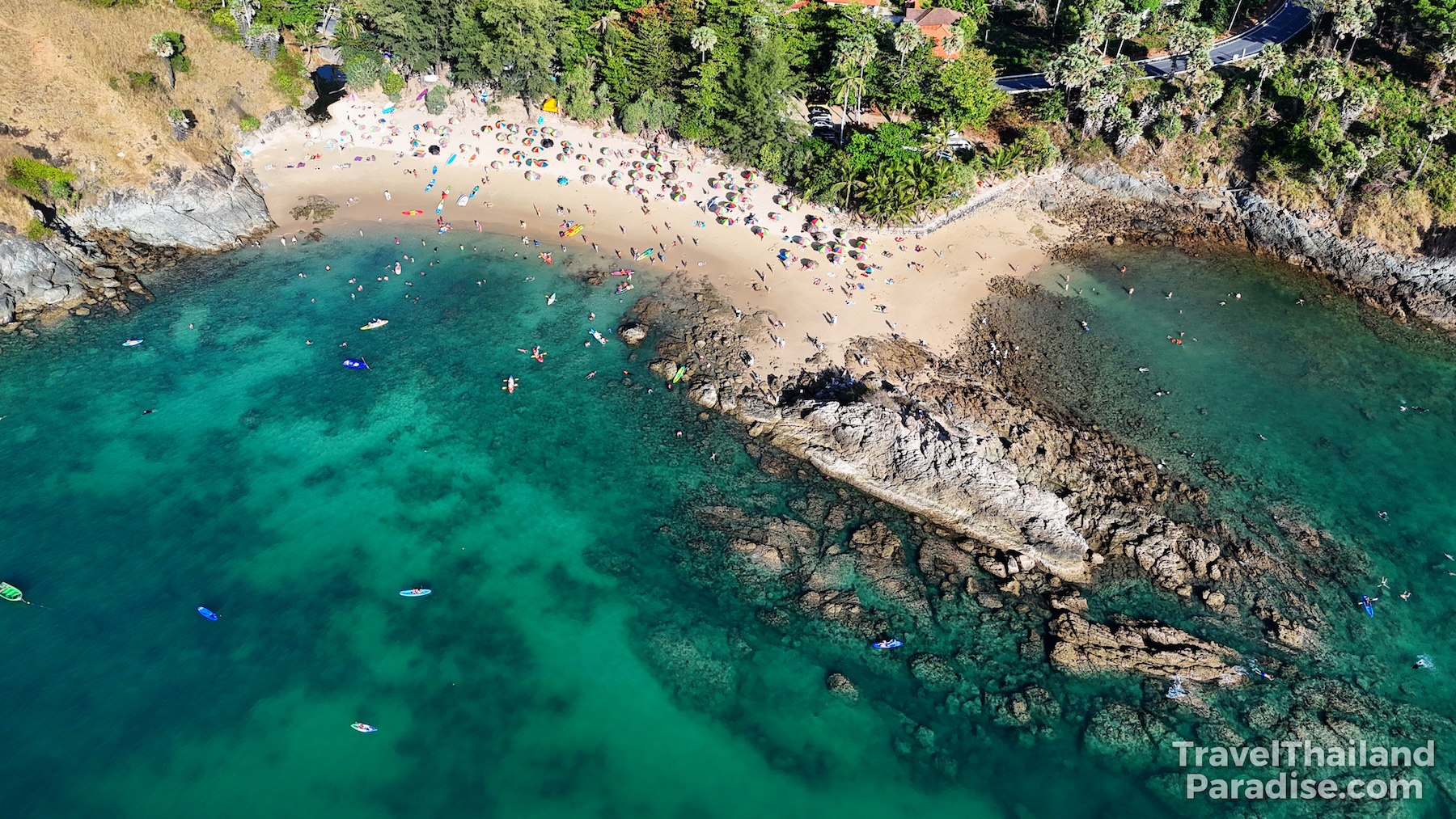
From the air, the shape of the cove becomes obvious.
You see the rocky boundaries.
The offshore island.
The contrast between emerald water and dense tropical greenery.
The winding coastal road climbing toward Windmill Viewpoint.
The small fishing boats floating offshore.
And suddenly you understand why photographers love this area.
From a drone perspective, Ya Nui feels less like a beach and more like a hidden pocket carved into the coastline.
It also highlights something many visitors miss.
The beach sits in one of the most scenic parts of Phuket.
Within minutes you can reach:
- Promthep Cape
- Windmill Viewpoint
- Nai Harn Beach
- Rawai
- Several coastal viewpoints
Very few beaches in Phuket combine all of those nearby attractions in such a compact area.
Why Snorkeling Is The Main Attraction
Most people don’t come to Ya Nui for sunbathing.
They come for what’s beneath the water.
The rocky edges of the bay create conditions that are often far better for snorkeling than many larger Phuket beaches. Various travel guides consistently mention Ya Nui as one of the island’s stronger shore-snorkeling locations.
The best areas are usually near the rocks rather than directly in the center of the beach.
Put on a mask and you’ll often find schools of tropical fish moving around the rocky formations.
The experience feels surprisingly accessible.
No tour boat.
No excursion package.
No full-day commitment.
Just walk into the water and start exploring.
Visibility varies depending on weather, tides, and season, but during calm conditions it can be remarkably clear.
For travelers staying in southern Phuket, that’s a huge advantage.
You get a snorkeling experience without needing to book an island trip.
Kayaking To The Island Offshore
Remember that small island visible from the beach?
This is where it becomes important.
Kayaks are commonly available for rent, and paddling across is one of the most popular activities at Ya Nui.
The distance isn’t intimidating.
Even beginners can usually make the crossing during calm conditions.
As you paddle away from shore, the perspective changes dramatically.
The beach shrinks.
The hills rise behind it.
The coastline unfolds in both directions.
And suddenly you’re seeing Ya Nui from an angle most visitors never experience.
Many travelers end up spending more time on the water than on the beach itself.
That’s unusual for Phuket.
But it makes perfect sense here.
The bay practically invites exploration.
Ya Nui Beach Versus Nai Harn Beach
This is a comparison many visitors naturally make.
The two beaches sit only minutes apart.
Yet they feel completely different.
Nai Harn feels bigger.
More open.
More developed.
If you’re looking for:
- More facilities
- More restaurants
- More space
Nai Harn probably wins.
If you’re looking for:
- Snorkeling
- Kayaking
- Photography
- A quieter atmosphere
Ya Nui often becomes the favorite.
Many travelers visit Nai Harn first because it’s more famous.
Then accidentally discover Ya Nui later.
And end up talking about Ya Nui more afterward.
The Reality Of Crowds
Let’s be realistic.
Ya Nui is no longer a secret.
The days when only locals knew about it are long gone.
Social media, travel blogs, and online maps have made sure of that.
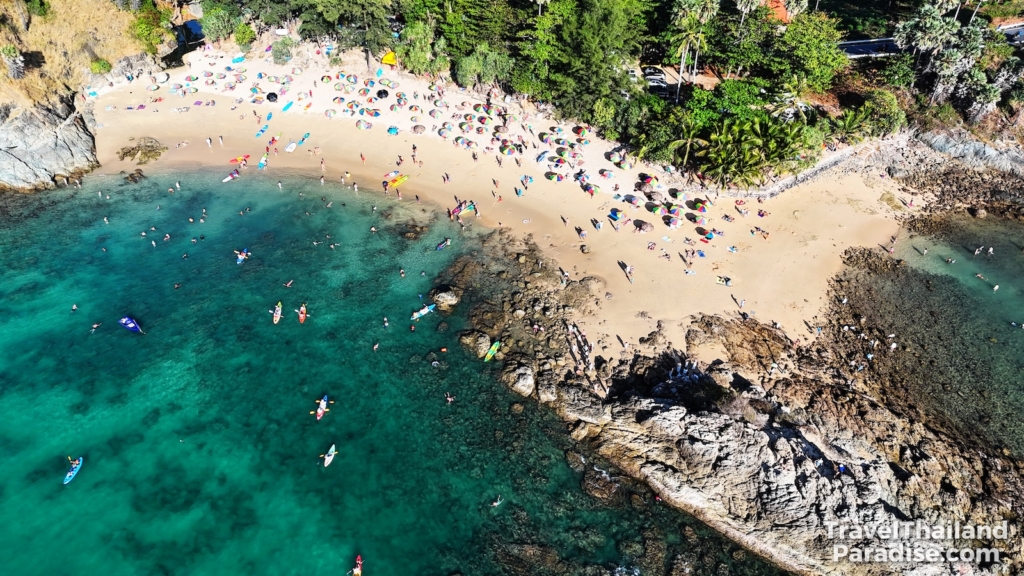
Because the beach is small, it can feel crowded much faster than larger beaches. Visitor reviews show mixed experiences, with some describing it as peaceful and others noting congestion during busy periods.
The difference often comes down to timing.
Arrive early.
Arrive late.
Visit during shoulder season.
Those experiences can feel completely different from arriving at midday during peak tourist season.
The beach itself hasn’t changed.
The number of people discovering it has.
Best Time To Visit Ya Nui Beach
Early morning is arguably the best time.
The air feels cooler.
Parking is easier.
The water is often calmer.
The lighting is excellent for photography.
Late afternoon offers another advantage.
As the harsh midday sunlight softens, the coastline begins to glow.
The nearby viewpoints become especially beautiful around sunset.
Many visitors combine Ya Nui Beach with a sunset stop at Promthep Cape or Windmill Viewpoint.
That combination creates one of the most enjoyable half-day itineraries in southern Phuket.
The Scenic Coastal Road That Makes Discovering Ya Nui Beach Feel Special
Part of what makes Ya Nui Beach memorable has nothing to do with the beach itself.
It’s the journey getting there.
Southern Phuket has some of the island’s most beautiful coastal roads, and Ya Nui happens to sit right in the middle of one of them.
Whether you’re driving a car or riding a scooter, the road connecting Nai Harn Beach, Windmill Viewpoint, and Promthep Cape feels completely different from the busier tourist areas further north.
There are no rows of high-rise hotels blocking the ocean.
No endless traffic lights.
No shopping centers dominating the landscape.
Instead, the road follows the natural shape of the coastline, climbing and descending gentle hills while revealing new ocean views around almost every corner.
One moment you’re surrounded by tropical vegetation.
The next, the Andaman Sea suddenly appears beside you, stretching toward the horizon.
Many visitors first discover Ya Nui Beach by accident while exploring this part of Phuket.
They might be heading toward Promthep Cape for sunset.
Perhaps they’re stopping at Windmill Viewpoint after visiting Nai Harn Beach.
Then they notice a small bay below the road and decide to pull over for a closer look.
That unexpected discovery is part of the reason Ya Nui leaves such a lasting impression.
Unlike Patong, Kata, or Karon, people rarely arrive with huge expectations.
There are no giant signs announcing its arrival.
No massive parking areas filled with tour buses.
No feeling that you’re entering one of Phuket’s major tourist attractions.
Instead, Ya Nui reveals itself gradually.
As the road curves around the hillside, the small crescent-shaped bay comes into view. The turquoise water contrasts with the surrounding greenery, and the tiny island sitting offshore immediately grabs your attention.
It’s the kind of scene that makes you instinctively slow down.
Many travelers who planned to spend fifteen minutes here end up staying several hours.
The surrounding viewpoints make the experience even better.
Windmill Viewpoint sits just above the beach and provides one of the most impressive perspectives in southern Phuket. Looking down from above, you can fully appreciate the shape of the cove, the rocky headlands, and the clear water that attracts snorkelers throughout the year.
Continue a few minutes farther south and you’ll reach Promthep Cape, one of Phuket’s most famous sunset locations.
Because everything is so close together, Ya Nui Beach rarely feels like a standalone destination.
Instead, it becomes part of a larger coastal adventure.
A morning exploring viewpoints.
An afternoon snorkeling in calm water.
A sunset overlooking the sea.
That combination is difficult to find elsewhere on the island.
And it’s one of the biggest reasons Ya Nui continues to attract travelers who prefer scenic drives, photography, and slower exploration over crowded tourist attractions.
What Ya Nui Beach Looks Like During Different Seasons
One of the reasons many travelers return to Ya Nui Beach more than once is that the bay can feel surprisingly different depending on the time of year.
Unlike some destinations that look almost identical month after month, Ya Nui changes with the seasons. The shape of the beach remains the same, but the atmosphere, water conditions, and overall experience can vary significantly.
During Phuket’s dry season, generally from November through April, Ya Nui shows the version most people see in travel photographs.
The sea often appears calm and clear. Shades of turquoise and deep blue become more visible, especially on sunny days when the sunlight reflects through the shallow water near the shore. This is also the period when snorkeling conditions are usually at their best.
The visibility underwater can be impressive after several days of calm weather. Fish become easier to spot around the rocky edges of the bay, and kayakers frequently make the short journey toward the island sitting offshore.
Not surprisingly, this is also when the beach receives the highest number of visitors.
The weather is comfortable.
Rainfall is limited.
The ocean is generally inviting.
For many travelers, this period represents the ideal version of Phuket.
But there is another side to Ya Nui that many visitors never experience.
When the rainy season arrives, typically between May and October, the atmosphere changes considerably.
The surrounding hills become even greener.
Vegetation appears thicker and more vibrant after regular tropical showers. The landscape often feels more alive, with fewer visitors and a quieter atmosphere throughout the bay.
Some days begin with sunshine before clouds roll in during the afternoon. Other days bring brief but intense tropical downpours that disappear as quickly as they arrive.
The weather becomes less predictable, but that unpredictability creates its own kind of beauty.
The sea can also look dramatically different.
Instead of perfectly calm turquoise water, waves occasionally roll into the bay, particularly when winds shift and storms pass through the Andaman Sea. Snorkeling conditions may not be as consistent as during the dry season, and visibility can vary from day to day.
For photographers, however, the rainy season often provides opportunities that don’t exist during the busier months.
The dramatic cloud formations above the coastline create more interesting skies. Sunsets can become spectacular when breaks in the clouds allow sunlight to illuminate the horizon. The contrast between dark tropical clouds and bright ocean water can produce some of the most memorable images of southern Phuket.
There is no universally perfect season to visit Ya Nui Beach.
Travelers looking for the clearest water and best snorkeling conditions will generally prefer the dry season.
Those who enjoy quieter beaches, lush landscapes, and a more relaxed atmosphere may find themselves appreciating the rainy season just as much.
Either way, Ya Nui manages to retain the quality that makes it special throughout the year.
It never feels overly developed.
It never feels artificial.
And regardless of the season, it continues to offer a small piece of Phuket that still feels connected to nature.
Who Will Enjoy Ya Nui Beach The Most?
Not every beach is right for every traveler.
That’s something many travel guides avoid saying.
Some beaches are built for nightlife. Others are ideal for families. Some attract surfers, while others appeal more to people looking for luxury resorts and beach clubs.
Ya Nui Beach occupies a different category altogether.
Its appeal depends less on what facilities it offers and more on the type of experience you’re looking for.
For couples, Ya Nui often feels like a pleasant discovery.
The small bay creates a more intimate atmosphere than many of Phuket’s larger beaches. There are no towering hotel developments dominating the scenery and no constant stream of activities competing for attention. Instead, couples can spend time swimming, snorkeling, or simply relaxing while enjoying the surrounding coastal landscape.
It’s not necessarily a romantic destination in the traditional sense.
You won’t find candlelit beachfront dining or luxury resorts directly overlooking the sand.
What you will find is a quieter environment where the natural setting remains the main attraction.
Solo travelers also tend to enjoy Ya Nui.
Part of the reason is its simplicity.
The beach is easy to visit, easy to navigate, and doesn’t require much planning. Whether arriving by scooter, car, or taxi, visitors can comfortably spend an hour or an entire afternoon here without feeling pressured to follow a schedule.
For solo travelers exploring southern Phuket, Ya Nui often works best as a place to slow down for a while between larger attractions.
Families with children can have a positive experience as well, particularly during calm weather conditions.
The relatively sheltered bay often provides gentler water than some of Phuket’s more exposed beaches. Children frequently enjoy exploring the shoreline, looking for small fish near the rocks, or watching kayakers heading toward the island offshore.
Parents should still keep realistic expectations.
This isn’t a beach packed with family-focused facilities, playgrounds, or organized activities. Families who enjoy nature and simple beach days will likely appreciate Ya Nui more than those searching for entertainment options.
Older travelers often find the beach appealing for a different reason.
The atmosphere feels manageable.
Large crowds, loud music, and hectic nightlife are largely absent. Many visitors simply sit beneath the shade, enjoy the ocean views, and appreciate the slower pace that characterizes this corner of Phuket.
At the same time, accessibility may be a consideration for some visitors. Parking can become limited during busy periods, and the surrounding area includes hills and viewpoints that may require a bit more walking than some travelers expect.
Perhaps the group most likely to feel disappointed are visitors arriving with unrealistic expectations.
If someone has spent days reading about Phuket’s most famous beaches, they may arrive expecting a massive stretch of sand filled with restaurants, water sports, shopping, and endless activity.
Ya Nui isn’t trying to compete with those destinations.
Its appeal is much more subtle.
The people who tend to enjoy Ya Nui the most are often those who appreciate smaller places, slower experiences, and destinations that still feel connected to the landscape around them.
For those travelers, the beach delivers exactly what they’re looking for.
Not excitement.
Not luxury.
Not nightlife.
Simply a beautiful corner of southern Phuket that offers a chance to pause, enjoy the sea, and experience a different side of the island.
Common Mistakes Visitors Make
Staying Only Fifteen Minutes
Many people stop because they happen to be driving past.
They take a few photos.
Look around.
Leave.
That’s not enough time.
The real appeal reveals itself once you slow down.
Forgetting Snorkeling Gear
Even if rentals are available, having your own mask makes spontaneous exploration easier.
Visiting Only During Peak Hours
Midday crowds can create a completely different experience.
Early morning often feels like a different beach altogether.
Skipping The Viewpoints
Some visitors never climb above the coastline.
That’s a mistake.
The views from the surrounding hills help explain why this area is so special.
Final Thoughts: Is Ya Nui Beach Actually Worth Visiting?
If you’re searching for Phuket’s biggest beach, Ya Nui isn’t it.
If you’re looking for luxury beach clubs, endless restaurants, or a packed nightlife scene, you won’t find those here either.
What you will find is something increasingly rare.
A beach that still feels connected to its surroundings.
A beach where snorkeling is often more important than posing for photos.
A beach where kayaking to a small island can become the highlight of your afternoon.
A beach that doesn’t need to be famous to be memorable.
That’s why Ya Nui tends to stay with people.
Not because it’s spectacular in the obvious way.
But because it feels genuine.
For photographers, drone pilots, snorkelers, and travelers exploring southern Phuket, the answer is easy.
Yes.
Ya Nui Beach is absolutely worth visiting.
Not for an entire week.
Not as the only beach on your Phuket itinerary.
But as one of those places that quietly reminds you why you started traveling in the first place.
And sometimes, those are the destinations you remember longest.
For official updates, visa requirements, you can also check the Tourism Authority of Thailand website.


