There are places in Thailand that you recognize before you ever set foot there. James Bond Island is one of them.
That strangely shaped limestone rock rising almost vertically from the green water of Phang Nga Bay has appeared on postcards, tour brochures, Instagram feeds, and travel advertisements for decades. Even travelers who have never watched a James Bond movie have probably seen it somewhere.
But arriving here feels different from simply seeing another photograph of it.
The journey through Phang Nga Bay is part of the experience. Limestone cliffs begin appearing in every direction, some rising almost straight out of the water. Small islands seem to hide behind larger ones, narrow channels open between enormous rock formations, and the scenery becomes increasingly dramatic as the boat moves deeper into the bay.
Then eventually, there it is.
Ko Tapu.
The famous narrow limestone pillar that most visitors simply know as James Bond Island.
And this is where the reality becomes a little more interesting than the photographs.
James Bond Island isn’t really just one rock. The famous Ko Tapu is actually a separate limestone formation standing offshore from Khao Phing Kan, the island where visitors get off their boats, walk around, and take the classic photographs.
The distinction doesn’t matter much when you’re standing there with a camera in your hand, but understanding it makes the place considerably more interesting.
It also reveals something that surprised me about visiting James Bond Island: the famous rock is only a small part of what makes this trip memorable.
The surrounding landscape of Phang Nga Bay is arguably just as impressive.
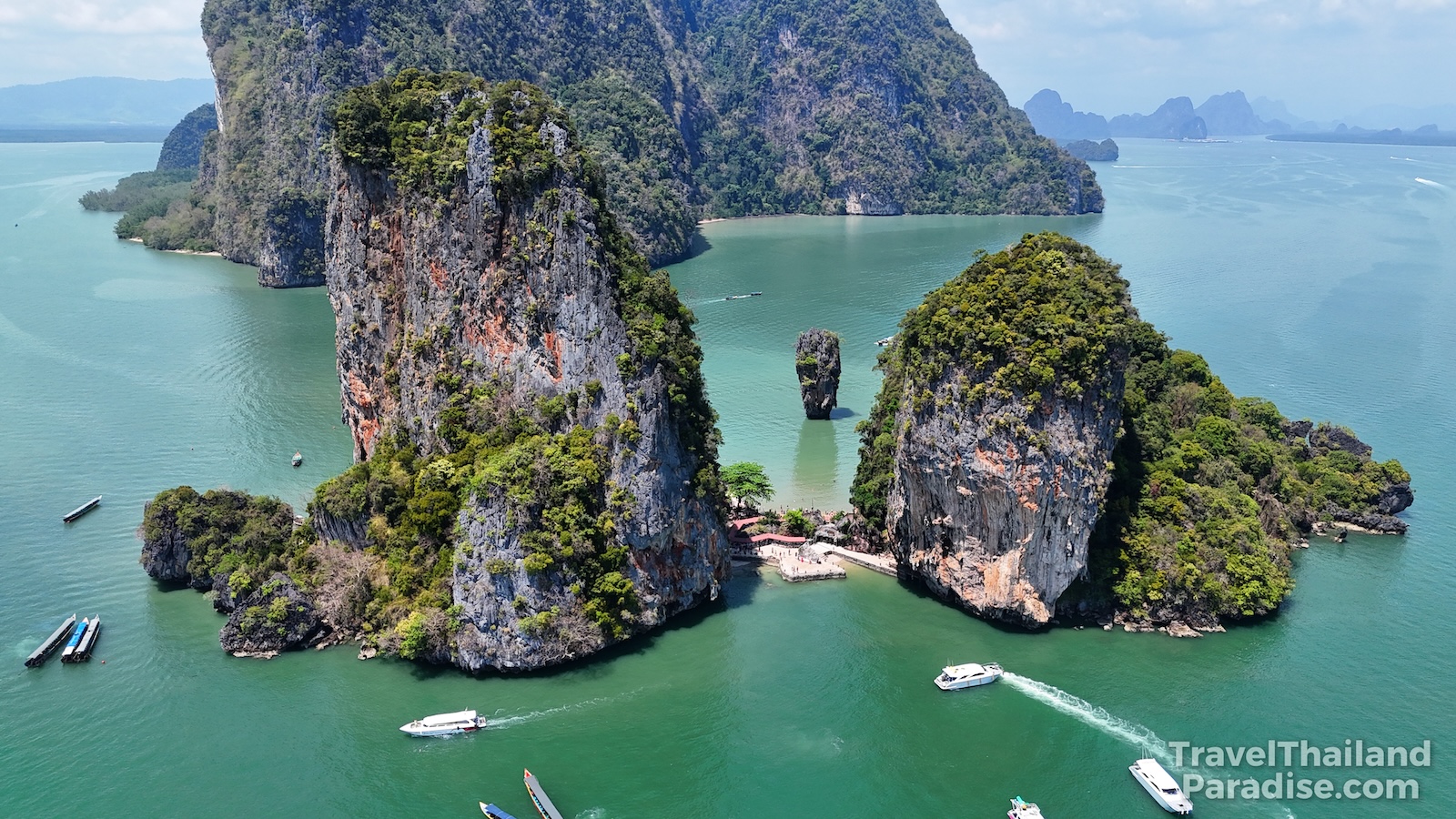
From water level, the limestone formations already look enormous. From above, however, the landscape takes on an entirely different character. Having seen this area from the air as well, I found that the drone perspective really shows how unusual James Bond Island’s location is. Ko Tapu isn’t an isolated attraction sitting somewhere by itself. It is surrounded by a maze of towering limestone islands, hidden waterways, cliffs, mangroves, and green water stretching across Phang Nga Bay.
That’s something the classic photograph doesn’t really show you.
And it’s one of several things worth knowing before you visit.
Quick Navigation
What You’ll Find in This James Bond Island Thailand Guide
- What James Bond Island is actually like beyond the famous postcard photographs
- The difference between Ko Tapu and Khao Phing Kan, and which one you actually visit
- How The Man with the Golden Gun turned this small corner of Phang Nga Bay into one of Thailand’s most recognizable landmarks
- What to expect when you arrive, from the famous viewpoint to the crowds and limited time many tours spend here
- How to visit James Bond Island and what to consider when choosing between group and private tours
- What else you can experience around Phang Nga Bay, including nearby attractions that pair naturally with James Bond Island
- Practical tips for timing your visit, photography, and making the most of your time on the island
- My own impressions from visiting James Bond Island — including perspectives of the landscape that are difficult to appreciate from ground level
First, James Bond Island Isn’t Exactly What You Think
One of the first things worth clearing up is what people are actually referring to when they say James Bond Island.
Most travelers picture the narrow limestone pillar rising from the water — the formation that appears on postcards, tour advertisements, and almost every photograph associated with the destination.
That famous rock is Ko Tapu.
You don’t actually walk onto it.
Visitors instead land on Khao Phing Kan, the larger island sitting directly beside it. From there, you can walk along the shoreline, explore beneath the limestone cliffs, and reach the viewpoints where the classic photographs of Ko Tapu are taken.
Over the years, the entire location has simply become known as James Bond Island.
I think knowing this before arriving actually makes the visit more interesting. Instead of treating Ko Tapu as the entire attraction, you start paying more attention to Khao Phing Kan and the surrounding landscape.
And there’s plenty to look at.
Towering limestone walls rise immediately behind the small shoreline areas, while cracks and passages between the rocks give parts of the island an almost enclosed feeling. Then you turn back toward the water and see Ko Tapu standing by itself offshore.
It’s an unusual contrast.
Khao Phing Kan feels massive and imposing when you’re standing beneath its cliffs. Ko Tapu looks almost delicate by comparison.
Yet that smaller formation became the star.
How a James Bond Movie Changed the Island Forever
Before 1974, this corner of Phang Nga Bay wasn’t an internationally recognized tourist attraction.
Then James Bond arrived.
Parts of The Man with the Golden Gun, starring Roger Moore as James Bond and Christopher Lee as Francisco Scaramanga, were filmed here. In the movie, the dramatic limestone landscape serves as part of Scaramanga’s island hideaway.
Ko Tapu appears prominently in the scenery.
That was enough to change the identity of the place permanently.
What had been a distinctive limestone formation in Phang Nga Bay suddenly became associated with one of the world’s most recognizable movie franchises.
Nearly everyone now calls it James Bond Island.
There is something slightly strange about standing there decades later and realizing that a few scenes from a movie transformed this small geological formation into an international travel destination.
Plenty of islands around Phang Nga Bay are larger.
Some have more dramatic cliffs.
Others have beaches where you could easily spend much longer.
But they don’t have James Bond.
That connection gave Ko Tapu something those other islands didn’t have: a story that traveled around the world.
Even if you’ve never seen The Man with the Golden Gun, you’ve probably encountered the image somewhere.
And when you finally stand on Khao Phing Kan looking across the water toward Ko Tapu, there is an undeniable moment of recognition.
That’s it.
That’s the rock.
But once that initial moment passes, I think the best thing you can do is turn around and start looking at everything else.
Because the movie made this place famous, but Phang Nga Bay is what makes it beautiful.
The Journey Through Phang Nga Bay Is Half the Experience
This is something I wouldn’t underestimate when planning a visit.
James Bond Island shouldn’t really be viewed as an isolated attraction.
The journey through Phang Nga Bay is part of the experience.
As the boat moves deeper into the bay, limestone formations begin appearing in almost every direction. Some rise like enormous walls from the water, while others stand alone like towers.
Vegetation somehow manages to grow across steep rock faces, giving the cliffs a mixture of dark limestone and dense tropical green.
The water below often has a greenish color rather than the bright turquoise associated with places such as the Phi Phi Islands.
It creates a completely different atmosphere.
Phang Nga Bay feels less like a traditional tropical beach destination and more like a flooded limestone landscape.
And the scenery keeps changing as you move through it.
A formation that looks like one solid island from a distance can reveal narrow channels or openings as the boat gets closer. Smaller islands disappear behind larger cliffs. New formations emerge as you round another corner.
For me, this is one of the reasons a James Bond Island excursion shouldn’t be judged purely by how much time you spend standing beside Ko Tapu.
The journey matters.
Seeing James Bond Island From Above
This became even more obvious when I saw the area from the air.
At ground level, Ko Tapu dominates your attention because you’re standing at the famous viewpoint looking directly toward it.
From above, the scale changes completely.
Ko Tapu suddenly becomes one small formation within an enormous landscape of limestone islands.
You can see how Khao Phing Kan fits into the surrounding bay and how many cliffs, channels, and islands stretch beyond the famous viewpoint.
It’s a perspective most visitors never really get from the shoreline.
And personally, I think it makes James Bond Island more impressive rather than less.
The aerial view puts the famous rock back into its natural setting.

What It’s Actually Like When You Arrive
This is where the postcard version of James Bond Island meets reality.
You’re visiting one of Thailand’s most recognizable attractions.
So yes, there can be crowds.
Tour boats arrive throughout the day, and many visitors naturally head toward the same place: the viewpoint overlooking Ko Tapu.
Everyone wants that photograph.
You may see people waiting for a clear spot, tour guides organizing groups, couples taking photographs of each other, and visitors trying to frame Ko Tapu without twenty strangers appearing in the background.
That’s part of visiting somewhere famous.
But I wouldn’t let that become the entire impression of the island.
Walk away from the main photo spot and start looking around Khao Phing Kan itself.
The limestone formations are fascinating up close.
One of the island’s distinctive features is the way enormous slabs of rock appear to lean against one another. In fact, the name Khao Phing Kan is commonly translated along the lines of “hills leaning against each other.”
Walking underneath these formations gives you a much better sense of their scale than photographs do.
There are also small pathways, rocky areas, sheltered sections beneath the cliffs, and different angles looking back toward the bay.
You don’t need hours to explore.
But you do need to resist the temptation to take the standard Ko Tapu photograph and immediately consider the visit finished.
The Famous Ko Tapu Viewpoint
Eventually, of course, you’ll end up at the viewpoint everyone came to see.
And despite having seen the image countless times beforehand, there is still something satisfying about seeing Ko Tapu in person.
The formation rises around 20 meters above the water, with a surprisingly narrow base supporting a wider upper section.
From certain angles, it looks almost unstable.
That’s part of what makes it so recognizable.
The unusual shape is the result of natural erosion over an enormous period of time. Wind, water, waves, and differences in the hardness of the limestone gradually shaped the formation we see today.
There is another important detail visitors should know.
You cannot simply swim or boat over to Ko Tapu and climb around it.
The formation is protected, and boats are kept away from the rock itself because of concerns about erosion and preserving the fragile limestone structure.
That’s a good thing.
The whole appeal of Ko Tapu is seeing that narrow column standing alone in the water.
It doesn’t need people climbing over it.
Don’t Take Only the Obvious Photograph
The classic photograph is obvious: stand on Khao Phing Kan with Ko Tapu behind you.
Take it.
You’re here.
But then experiment.
Move farther along the shoreline.
Use the surrounding limestone cliffs to frame the rock.
Photograph the boats passing through the bay.
Look back toward Khao Phing Kan rather than constantly pointing your camera toward Ko Tapu.
If conditions allow, reflections and changing light on the water can completely change the appearance of the scene.
And if you’re interested in photography, pay attention to scale.
A boat passing near the formation can actually make a photograph more interesting because it shows just how large the limestone landscape is.
The same principle applies to drone footage.
Getting closer isn’t automatically better.
Sometimes pulling back and allowing Ko Tapu to become one element within the wider landscape creates the stronger image.
How Much Time Do You Actually Need at James Bond Island?
Probably less than you might expect.
James Bond Island isn’t the type of destination where most travelers need half a day on the island itself.
For many visitors, somewhere around 30 to 60 minutes on Khao Phing Kan is enough to see Ko Tapu, explore the main walking areas, take photographs, and appreciate the limestone formations.
That can initially sound disappointing.
I don’t think it should.
James Bond Island works best as part of a larger Phang Nga Bay experience rather than as a destination where you arrive at 9 a.m. and stay until sunset.
Think of it as the centerpiece of a journey through the bay.
You come for the famous landmark, spend enough time to explore it without rushing, and then continue through a landscape containing caves, mangroves, limestone cliffs, villages, and other islands.
This is also why the quality of the tour matters.
A tour that gives you enough time to look around and combines James Bond Island with genuinely interesting stops can feel like a full day of exploration.
A rushed tour that treats every destination as a ten-minute photo opportunity can feel very different.
And that brings us to one of the most important decisions when planning the trip:
how you choose to visit James Bond Island.
How to Visit James Bond Island
There are no roads leading to James Bond Island, which means every visit eventually involves getting onto a boat.
For most travelers, that’s part of the appeal.
The most common option is joining a day trip that explores several locations around Phang Nga Bay. Tours are widely available from Phuket, while travelers staying closer to Phang Nga can reach the bay without making the longer journey from Phuket.
Depending on the tour, transportation might involve a speedboat, larger tour boat, or traditional longtail boat for portions of the journey.
The experience can be quite different depending on which one you choose.
Speedboats cover larger distances quickly and allow tours to fit several destinations into a single day. Larger boats generally provide more space and a slower pace. Longtail boats give the journey a more traditional Thai feel and can be particularly enjoyable when traveling through the dramatic limestone scenery.
But I wouldn’t choose a tour based only on the type of boat.
Look at the actual itinerary.
A tour advertising ten stops isn’t automatically better than one advertising five. Sometimes it simply means you’ll spend less time at each destination.
I’d rather have enough time to actually experience a few interesting places than spend the entire day getting on and off boats.
Group Tour or Private Tour?
This is one destination where choosing between a group and private tour can significantly change the experience.
Group Tours
For most first-time visitors, a group tour is the easiest option.
Transportation is organized, the itinerary is already planned, and several Phang Nga Bay attractions are usually included in the same day.
They’re also generally much more affordable than chartering your own boat.
The compromise is flexibility.
If your group arrives at James Bond Island during a busy period, you can’t simply decide to wait an hour for the crowds to disappear. When the guide says it’s time to leave, it’s time to leave.
For travelers who mainly want to see the famous landmark and experience the highlights of Phang Nga Bay without worrying about logistics, that’s perfectly reasonable.
Private Tours
A private tour becomes much more interesting if photography, video, or simply avoiding the busiest periods is important to you.
You have greater control over the pace and, depending on the operator and conditions, may have more flexibility over the order in which locations are visited.
That can make a noticeable difference at James Bond Island.
Arriving before or after large tour groups can completely change the atmosphere of the famous viewpoint.
Private tours obviously cost more, particularly for solo travelers, but the price becomes easier to justify when several people are sharing the boat.
If I were visiting specifically to concentrate on photography or filming rather than simply sightseeing, this is the option I would seriously consider.
What Else Should You See Around Phang Nga Bay?
This is where I think some travelers make a mistake.
They book a “James Bond Island tour” and assume James Bond Island needs to be the highlight of every minute of the day.
It doesn’t.
One of the best things about visiting is that it gives you an excuse to explore Phang Nga Bay itself.
The bay contains limestone cliffs, mangrove forests, caves, small islands, sheltered waterways, and communities that have adapted to living in this unusual environment.
Depending on your itinerary, the places you visit before and after James Bond Island may end up being just as memorable.
Koh Panyee Floating Village
One of the most interesting combinations is James Bond Island and Koh Panyee.
Koh Panyee is a predominantly Muslim fishing community built largely over the water beneath an enormous limestone cliff.
The setting couldn’t be more different from James Bond Island.
At Ko Tapu, everyone is looking toward one famous geological formation.
At Koh Panyee, the interesting part is seeing how an entire community developed in such an unusual location.
Homes, restaurants, shops, walkways, a mosque, and even the village’s famous floating football pitch occupy the limited space between the sea and the towering limestone backdrop.
I found Koh Panyee particularly interesting from the air as well. From ground level, you’re walking through narrow passages between buildings and may not fully appreciate the scale of the village. From above, you can see how much of the community extends over the water and just how dramatically the limestone cliff rises behind it.
If your James Bond Island tour includes Koh Panyee, I wouldn’t treat it as simply the lunch stop.
Take some time to explore.
Read my complete Koh Panyee Floating Village Travel Guide
Canoeing and Sea Caves
Another activity commonly associated with Phang Nga Bay is canoeing or kayaking around limestone caves and sheltered waterways.
This gives you almost the opposite perspective from the drone views.
From above, you appreciate the enormous scale of the landscape.
From a canoe, you’re almost at water level.
You may pass beneath overhanging limestone, through narrow cave entrances, or into sheltered areas surrounded by cliffs.
It’s a much slower experience than traveling between attractions by speedboat, and that change of pace can be one of the most enjoyable parts of the day.
If I were comparing tour itineraries, I would place considerably more value on meaningful canoeing time than on squeezing another quick photo stop into the schedule.
When Is the Best Time to Visit James Bond Island?
For most travelers, the dry season from roughly November through April offers the most favorable conditions for exploring Phang Nga Bay.
Rainfall is generally lower, skies are more likely to be clear, and boat conditions tend to be more predictable.
That doesn’t mean James Bond Island becomes inaccessible for the rest of the year.
Phang Nga Bay receives visitors year-round.
The wetter months can bring dramatic skies, fewer tourists, and intensely green scenery. The trade-off is a greater possibility of rain, rougher conditions, and changes to boat itineraries.
There’s another factor I think matters almost as much as the month you visit:
The Time of Day
James Bond Island is famous.
Famous places attract tour groups.
If several boats arrive within a similar window, the relatively small areas around the main Ko Tapu viewpoint can become busy very quickly.
This is where an early departure or a tour deliberately designed around avoiding peak periods can be worthwhile.
If photography is particularly important to you, I’d prioritize timing over trying to cram the maximum number of attractions into one day.
Twenty relatively peaceful minutes at the viewpoint may be more valuable than an extra stop somewhere else.
What Should You Bring?
You don’t need specialized equipment for James Bond Island, but a few things make the day considerably more comfortable.
Bring sun protection, including sunscreen, sunglasses, and ideally a hat. Even when you’re moving between shaded limestone formations, you’ll spend plenty of time exposed to tropical sun on the boat and shoreline.
Wear footwear you’re comfortable using around boats, sand, and potentially wet surfaces. Me personally I prefer water shoes. Water shoes can protect your feet, from sharp rocks, and sea urchins. Stepping on sea urchins is definitely a painful experience, that can ruin your whole day, if not your whole week.
Bring water, although many organized tours provide drinking water and refreshments.
And protect anything that doesn’t appreciate seawater.
A waterproof pouch or dry bag is particularly useful for phones, wallets, cameras, and other electronics — especially if your itinerary includes canoeing.
I’d also bring more than one camera battery if you’re filming.
Phang Nga Bay has a habit of making you keep the camera running.
Mistakes I’d Avoid When Visiting James Bond Island
The first would be arriving with the expectation that you’re going to discover a deserted secret island.
You’re not.
James Bond Island is famous precisely because millions of people know what it looks like.
Accepting that before you arrive makes it much easier to enjoy the experience for what it is.
The second mistake would be concentrating exclusively on Ko Tapu.
Take the famous photograph, but then look around.
Explore Khao Phing Kan.
Look upward at the limestone formations.
Watch the boats moving between the cliffs.
Pay attention to the landscape while traveling through the bay.
The third would be choosing a tour based entirely on the number of stops advertised.
More isn’t always better.
And finally, don’t spend the entire visit looking through your phone.
That sounds like standard travel advice, but James Bond Island is exactly the kind of place where it’s easy to do.
You arrive at something you’ve seen hundreds of times online, immediately start photographing it, move to another angle, take another photograph, record some video, and suddenly your guide is calling everyone back to the boat.
Get the pictures you want.
Then put the camera away for a few minutes and actually look at the place.
The View Most Visitors Never See
This was one of the most interesting parts for me.
Standing on Khao Phing Kan gives you the famous perspective.
Flying above it gives you an entirely different one.
From the air, Ko Tapu no longer overwhelms the scene.
Instead, your attention starts moving outward.
You notice the shape of Khao Phing Kan, the surrounding limestone formations, boats leaving trails across the water, and islands appearing one behind another toward the horizon.
It also becomes obvious why Phang Nga Bay has such a distinctive character.
There isn’t one dramatic island.
There are dramatic formations everywhere.
From certain angles, Ko Tapu almost disappears into the landscape despite being the reason many visitors came here in the first place.
I actually like that.
It puts the famous landmark into perspective.
[DRONE VIDEO #3 — YOUR MOST UNUSUAL AERIAL ANGLE OF JAMES BOND ISLAND]
This is where I would use the drone video that’s visually the most different from the other two.
So, What Nobody Tells You About James Bond Island
The biggest surprise about James Bond Island is that the famous rock isn’t necessarily the most impressive thing about the day.
Ko Tapu is iconic.
Seeing it in person is fun precisely because you’ve probably seen the image long before arriving in Thailand.
But the experience becomes much better when you stop treating that photograph as the entire reason for going.
The boat journey through Phang Nga Bay matters.
Khao Phing Kan matters.
The enormous limestone cliffs matter.
Places such as Koh Panyee and the caves and sheltered waterways around the bay add completely different experiences to the journey.
And seeing the landscape from above gave me an even greater appreciation for just how small Ko Tapu actually is compared with everything surrounding it.
That’s what photographs of the famous rock rarely communicate.
James Bond may have put this particular island on the international tourism map, but Phang Nga Bay is the real setting that makes the visit special.
Come expecting a famous attraction and, yes, probably some crowds.
Take the classic photograph.
Learn why everyone calls a small limestone pillar James Bond Island.
But then look beyond it.
Because once you do, you’ll realize that one of Thailand’s most photographed rocks is sitting in the middle of a landscape that’s far more interesting than the movie connection that made it famous.
Frequently Asked Questions About James Bond Island Thailand
Where is James Bond Island?
James Bond Island is located in Phang Nga Bay in Phang Nga Province, between Phuket and the mainland of southern Thailand. It is part of Ao Phang Nga National Park and can only be reached by boat.
What is the real name of James Bond Island?
The name can be slightly confusing because two different formations are involved.
The famous narrow limestone pillar standing in the water is called Ko Tapu, while the larger island where visitors actually land is Khao Phing Kan. The entire location became popularly known as James Bond Island after appearing in the 1974 movie The Man with the Golden Gun.
Can you visit James Bond Island from Phuket?
Yes. Phuket is one of the most popular starting points for James Bond Island tours. Most excursions include transportation to a pier followed by a boat trip through Phang Nga Bay. James Bond Island is normally combined with other attractions rather than being the only stop of the day.
Can you stay overnight on James Bond Island?
No. James Bond Island isn’t a resort island with hotels or beachfront accommodation. Visitors arrive as part of boat excursions and leave again afterward.
If you want to spend more time exploring the region, staying elsewhere in Phang Nga or Phuket and taking a day trip into the bay is the more practical option.
Can you climb Ko Tapu?
No. Visitors view Ko Tapu from Khao Phing Kan rather than climbing the famous limestone formation.
Protecting the rock is particularly important because its unusual narrow base has been shaped by natural erosion. The fact that people cannot climb all over it also helps preserve the landmark that everyone came to see.
Can you swim at James Bond Island?
James Bond Island shouldn’t be chosen primarily as a swimming destination.
There are small shoreline areas around Khao Phing Kan, but this isn’t the kind of island I would visit expecting several hours of swimming and relaxing on a tropical beach.
The main attractions are the limestone scenery, Ko Tapu, photography, movie history, and the wider journey through Phang Nga Bay.
If beautiful beaches and swimming are your priorities, there are much better islands in southern Thailand for that experience.
Is James Bond Island suitable for families?
For most families, yes.
The boat journey, unusual limestone scenery, and recognizable James Bond landmark can make it an interesting excursion even for children who know nothing about the movie.
However, parents should consider the length and pace of the particular tour. A full-day itinerary involving numerous boat transfers and stops can be tiring for very young children.
Do you need to watch The Man with the Golden Gun before visiting?
Definitely not.
The James Bond connection explains why the location became internationally famous, but you don’t need to know anything about the movie to appreciate Phang Nga Bay.
That said, watching the movie before your trip can make arriving at Ko Tapu slightly more entertaining. You’ll immediately recognize why this unusual landscape worked so well as a movie location.
Is James Bond Island only worth visiting because of the movie?
I don’t think so.
The movie made Ko Tapu famous, but the surrounding landscape is what gives the excursion much of its appeal.
If the famous rock were sitting by itself in an otherwise ordinary location, I probably wouldn’t find the experience nearly as interesting.
Instead, it’s surrounded by the towering limestone formations, islands, waterways, caves, and mangroves of Phang Nga Bay.
That’s why I wouldn’t think of the trip simply as visiting a James Bond filming location.
You’re using James Bond Island as a gateway to explore one of southern Thailand’s most distinctive landscapes.
For official updates, visa requirements, you can also check the Tourism Authority of Thailand website.


