Quick Navigation
Quick Overview (What You Need to Know Before You Go)
- Located in Phi Phi Islands, inside a protected natural lagoon surrounded by towering limestone cliffs
- Famous for its glowing emerald-turquoise water that changes color throughout the day
- Accessible only by boat — no roads, no hotels, no infrastructure
- Best visited early morning or late afternoon to avoid crowds
- One of the most photogenic locations in Thailand, especially for drone footage
- Calm, enclosed water makes it perfect for swimming and floating
- Usually visited together with Maya Bay and nearby islands
Why Phi Leh Lagoon Thailand Feels Different From Anywhere Else
There are places in Thailand that look beautiful the moment you arrive.
And then there are places that slowly reveal themselves — where the experience builds step by step, until you realize you’re somewhere completely different.
Phi Leh Lagoon is one of those places.
It doesn’t overwhelm you at first. It doesn’t try to impress you instantly. Instead, it pulls you in gradually — through the movement of the water, the shape of the cliffs, the silence that replaces the noise of the open sea.
By the time you fully understand where you are, you’re already inside it.
And that’s what makes it unforgettable.
The Approach: From Open Sea to a Hidden World
There’s a point on the way to Phi Leh Lagoon Thailand where the journey starts to feel different.
At first, it’s just open water.
The boat cuts across the Andaman Sea, steady and predictable, with nothing but horizon in every direction. If you’re coming from Phuket or Ao Nang, the ride feels familiar — blue water, scattered islands in the distance, the occasional longtail boat passing by.
It’s beautiful, but nothing unusual yet.
Then slowly, almost without realizing it, the scenery begins to change. The islands start getting closer. The cliffs become steeper.
The water begins to shift in color — from deep ocean blue to something lighter, clearer, almost glowing beneath the surface.
And then you see it.

At first, it doesn’t look like much.
Just a narrow opening between towering limestone cliffs, partially hidden, easy to miss if you weren’t paying attention. There’s no sign, no marker, nothing that announces what’s ahead.
But as the boat moves closer, something feels different. The captain slows down. The engine softens.
And just before entering, there’s a brief moment where everything seems to pause — like the outside world is about to be left behind.
Then you pass through the opening. And everything changes.
Inside Phi Leh Lagoon Thailand: A Shift in Atmosphere
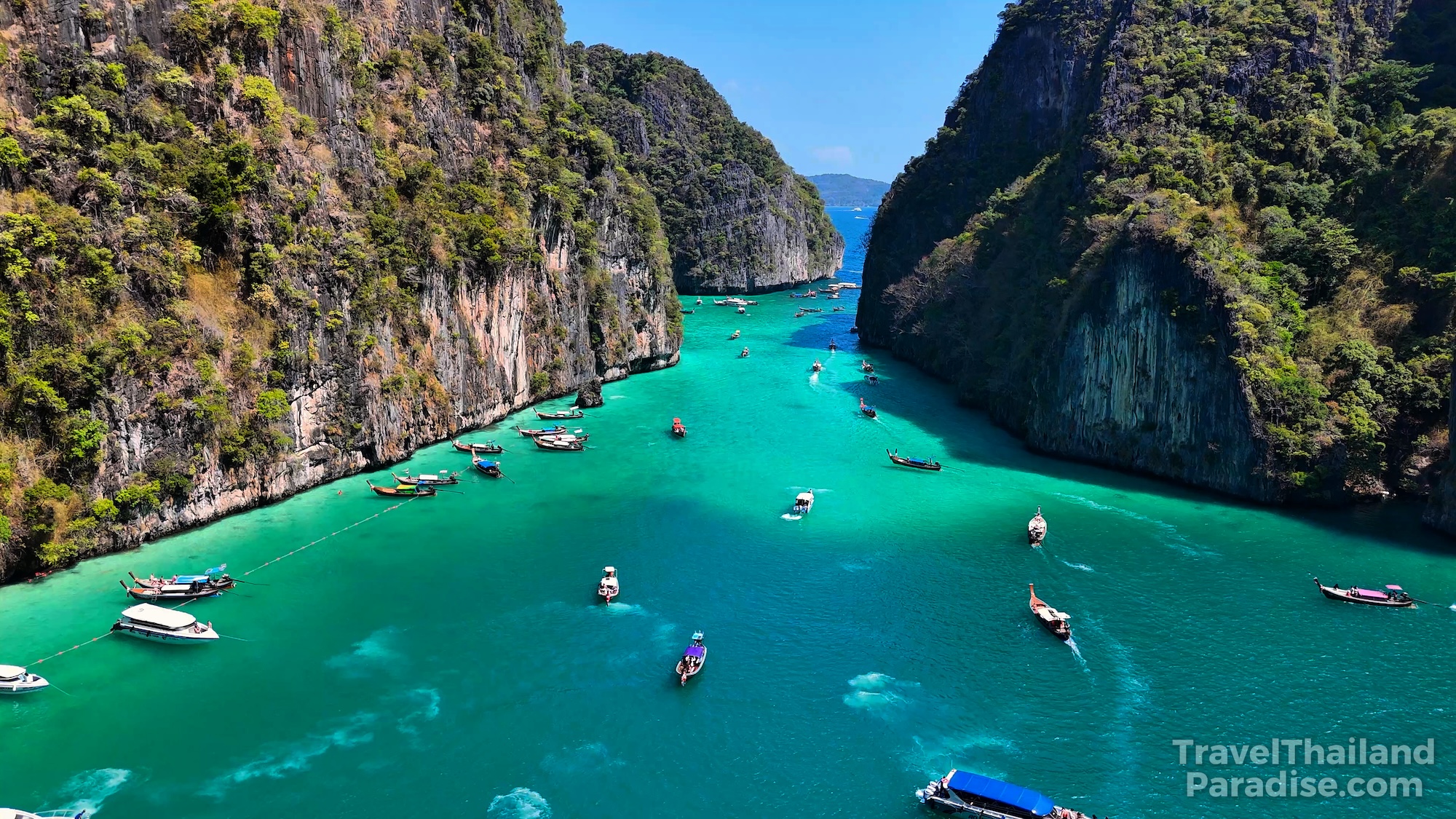
The first thing you notice isn’t just the color of the water — it’s the stillness. The waves disappear almost instantly.
What was once open sea becomes something completely calm, almost like a natural swimming pool enclosed by massive cliffs. The water flattens, reflecting the limestone walls that rise vertically around you.
It doesn’t feel like the ocean anymore. It feels contained. Protected. Hidden.
The cliffs are overwhelming in the best possible way.
They don’t slope gently like most coastlines — they rise straight up, forming a natural barrier that isolates the lagoon from everything outside. Covered in patches of green vegetation, they create a contrast against the bright water below that almost looks unreal.
And then there’s the color.
Phi Leh Lagoon Thailand is famous for its turquoise water — but what makes it special is that it never stays the same.
Depending on the light, the depth, and the angle of the sun, it shifts constantly:
- Bright turquoise in shallow areas
- Deep emerald in the center
- Soft jade tones where shadows from the cliffs fall
If you stay long enough, you’ll notice that the lagoon is always changing — even within minutes.
The Feeling Most People Don’t Expect
What surprises most visitors isn’t just how it looks. It’s how it feels. There’s a natural quietness here that you don’t get on beaches.
Even with boats around, the sound behaves differently. It echoes softly against the cliffs, never fully breaking the calm atmosphere. The space absorbs noise rather than amplifying it.
Time feels slower. People speak more quietly. Boats drift instead of rushing.
And for a moment, you stop thinking about everything else — no schedule, no next destination, no rush to move on.
You just float in it.
Take it in.
And that’s when Phi Leh Lagoon stops being just a place you visit…
…and becomes something you actually experience.
Why This Moment Defines the Entire Trip
Most itineraries list Phi Leh Lagoon Thailand as just another stop. But this moment — the entrance, the transition, the stillness — is what makes it unforgettable.
Because unlike many destinations that look exactly like their photos, this one feels different in real life. It’s not just visual. It’s immersive.
And if you experience it at the right time — when the water is calm, the light is soft, and the crowds are minimal — it can easily become the highlight of your entire trip to Thailand.
Where Exactly Is Phi Leh Lagoon Thailand?
Phi Leh Lagoon Thailand is located deep within the southern part of the Phi Phi Islands — a cluster of dramatic limestone islands floating in the Andaman Sea.
More specifically, the lagoon sits on Koh Phi Phi Leh, the smaller, uninhabited island just south of Koh Phi Phi Don.
This detail matters more than most people realize.
Because unlike Phi Phi Don — where you’ll find hotels, restaurants, nightlife, and crowds — Phi Phi Leh is completely untouched.
No roads. No buildings. No permanent residents. Only nature.
Part of a Protected National Park
Phi Leh Lagoon isn’t just a beautiful place — it’s also protected.
It falls within Hat Noppharat Thara Mu Ko Phi Phi National Park, a designated conservation area that includes multiple islands, coral reefs, and marine ecosystems.
This protection is one of the reasons the lagoon still looks the way it does today.
There are rules. Restrictions. And limitations on what can and cannot happen inside the lagoon.
You won’t see jet skis here. You won’t see large commercial developments. And you won’t find the kind of infrastructure that exists on nearby islands.
Everything remains minimal — and that’s intentional.
Why the Location Feels So Isolated
On a map, Phi Leh Lagoon Thailand doesn’t look that far from popular destinations.
- 1 hour from Phuket
- 45 minutes from Krabi / Ao Nang
- 15–20 minutes from Koh Phi Phi Don
But once you’re inside the lagoon, distance stops mattering. Because you can’t see anything else. The cliffs block the horizon completely.
There’s no visual connection to the outside world — no distant hotels, no passing ferries, no signs of civilization.
That’s what creates the illusion of isolation.
Even though you’re relatively close to some of Thailand’s busiest tourist areas, it feels like you’ve stepped into a place that exists entirely on its own.
The Connection to Maya Bay (And Why Most People Visit Both)
Just a short distance away — on the same island — is Maya Bay. Because of this, most tours combine the two locations into a single itinerary.
And on paper, it makes sense:
- Both are located on Koh Phi Phi Leh
- Both are among the most famous places in Thailand
- Both are accessible only by boat
But the experience is completely different.
Maya Bay is open. It faces outward toward the sea. It’s wide, bright, and exposed.
Phi Leh Lagoon is the opposite.
- Enclosed
- Calm
- Hidden
- More immersive
That’s why many travelers — especially those who visit early or late in the day — end up preferring Phi Leh Lagoon over Maya Bay.
Not because it’s more famous. But because it feels more personal.
Why You Can’t Stay Here (And Why That’s a Good Thing)
One of the most common questions people ask is: “Can you stay overnight at Phi Leh Lagoon?”
The answer is no.
There are no hotels, no bungalows, no accommodation of any kind on Koh Phi Phi Leh. At first, that might sound like a limitation.
But in reality, it’s one of the biggest reasons the lagoon still feels untouched. If development were allowed here, the entire experience would change.
You would have:
- Noise at night
- Artificial lighting
- Increased boat traffic
- More environmental pressure
Instead, everything resets every day. Boats come and go. Visitors arrive and leave. And the lagoon returns to stillness.
Why This Location Matters More Than You Think
A lot of travel guides mention where Phi Leh Lagoon Thailand is located — but they don’t explain why it matters.
This isn’t just a point on a map. It’s the reason the experience feels the way it does.
Because:
- It’s enclosed by cliffs → creates still water
- It’s protected → prevents overdevelopment
- It’s uninhabited → removes distractions
- It’s boat-access only → controls how people arrive
All of these factors combine to create something rare:
A place that still feels natural, even after becoming famous.
The Best Way to Visit Phi Leh Lagoon Thailand (And What Changes Everything)
There’s one decision that will define your entire experience at Phi Leh Lagoon Thailand.
Not the camera you bring.
Not the weather.
Not even the season.
It’s how you choose to visit.
Because this place can feel like two completely different worlds — depending on one simple choice.
Group Tours: Easy, Popular… and Predictable
Most people visit Phi Leh Lagoon as part of a group tour.
These typically depart from Phuket, Krabi, or Ao Nang, and include multiple stops such as Maya Bay, snorkeling spots, and sometimes Monkey Beach.
On paper, it sounds ideal. You cover multiple locations. Everything is organized. And the price is relatively affordable.
But once you experience it, you begin to notice the limitations.
What It Actually Feels Like
You don’t arrive when you want. You arrive when the schedule says so. And that usually means entering the lagoon at the same time as dozens of other boats.

The result?
- More noise
- Less space
- Less time to enjoy the water
- A slightly rushed experience
It’s still beautiful — there’s no denying that.
But it feels more like a stop… than a moment.
Private Longtail Boat: Where Everything Changes
Now imagine the same place — but without the rush. No fixed schedule. No group waiting behind you. No pressure to leave after 20–30 minutes.
This is what happens when you choose a private longtail boat.
Most commonly arranged from Koh Phi Phi Don, these traditional wooden boats offer something speedboats can’t: control
And that control changes everything.
The Difference You Feel Immediately
Instead of following a route, you create your own.
You decide:
- When to leave
- When to arrive
- How long to stay
- When to enter the lagoon
And that last point is the most important.
Because timing Phi Leh Lagoon Thailand correctly can turn a crowded destination into something that feels completely private.
The Hidden Strategy Most Tourists Don’t Know
Here’s something most guides don’t tell you. You don’t have to go straight into the lagoon. If you arrive and see multiple boats already inside, you can simply wait. Drift outside.
Give it 10–15 minutes.
And then enter when the space clears.
That one small decision can completely transform your experience.
Instead of navigating through boats and noise, you enter into:
- Calm water
- Open space
- A quieter atmosphere
It’s a completely different feeling.
Speedboats vs Longtail Boats (Important Difference)
Speedboats are fast. Efficient. Designed to move quickly between locations.
But they also feel disconnected from the environment.
You sit higher above the water. You move faster. You spend less time actually experiencing the journey.
Longtail boats are the opposite.
- Slower
- Closer to the water
- More immersive
You feel the movement of the sea. You notice the details. You become part of the environment, instead of just passing through it.
And at a place like Phi Leh Lagoon Thailand, that difference matters.
Quick Comparison (For Clarity)
| Option | Experience | Flexibility | Atmosphere |
|---|---|---|---|
| Group Tour | Structured | None | Busy |
| Speedboat Private | Fast | Medium | Less immersive |
| Longtail Private | Fully customizable | High | Most authentic |
The One Choice That Defines Everything
If you’re short on time or traveling on a budget, group tours are fine. You’ll still see the lagoon. You’ll still recognize its beauty.
But if you want to actually feel it — to experience it the way it’s meant to be experienced — the choice is clear.
Private longtail boat. Not because it’s more exclusive. But because it gives you something far more valuable:
the right moment
Why This Matters More Than Price
Many people hesitate because of cost.
But when you break it down — especially if you’re sharing with 2–4 people — the difference isn’t as big as it seems.
And what you gain in return isn’t just convenience. It’s the entire experience.
Because Phi Leh Lagoon Thailand isn’t just about being there. It’s about how you arrive… and when.
Best Time to Visit Phi Leh Lagoon Thailand (This Changes Everything)
If there’s one factor that completely transforms your experience at Phi Leh Lagoon Thailand, it’s timing.
Not slightly. Completely.
Because this is not a place that feels the same throughout the day.
Early Morning: When It Feels Unreal
Arriving early — ideally before 9 AM — is the closest you’ll get to seeing Phi Leh Lagoon the way it exists in your imagination.
This is when everything aligns. The water is almost perfectly still. The surface reflects the cliffs like glass.
The colors feel softer, more natural — shifting gently between turquoise and emerald without the harsh brightness of midday sun.
And most importantly:
There are very few boats. Sometimes just one or two. Sometimes none at all. You can float freely without navigating around crowds.
You can take photos without waiting for space to clear. You can actually hear the quiet.
This is when Phi Leh Lagoon Thailand feels less like a destination… and more like a hidden world.
Midday: The Version Most People See
By late morning into early afternoon, the atmosphere changes. Tour boats begin arriving in waves — especially from Phuket and Ao Nang.
The lagoon fills up. Boats enter and exit more frequently.
The water, while still beautiful, becomes more disturbed — losing that glass-like stillness that makes it so special.
The light also becomes harsher.
Stronger sunlight flattens the colors slightly, making them appear less dynamic compared to early morning or late afternoon.
It’s still impressive. But it doesn’t feel the same.
Late Afternoon: The Underrated Window
As the day begins to wind down, something interesting happens. The crowds slowly disappear. Tour boats leave. The lagoon starts to calm again.
And the light shifts into warmer tones — giving the water a slightly deeper, richer color.
It’s not as perfectly still as early morning.
But it’s close.
And in some ways, even more atmospheric.
This is one of the most underrated times to visit Phi Leh Lagoon Thailand — especially if you’re staying on Koh Phi Phi Don and have flexibility.
The One Mistake Most People Make
Most visitors don’t choose their time. They follow a schedule.And that schedule almost always puts them in the lagoon between:
11 AM – 2 PM
Which is exactly when:
- Boat traffic is highest
- Water is most disturbed
- The atmosphere is least peaceful
This is why some people leave feeling slightly underwhelmed — not because the place isn’t incredible, but because they experienced it at the wrong time.
Can You Swim in Phi Leh Lagoon Thailand?
Yes — and it’s one of the highlights of visiting.
But the experience depends on conditions.
What It Feels Like
The water is warm. Calm. And incredibly clear. There are no strong waves pulling you. No currents pushing you away.
You simply float — surrounded by towering cliffs that make everything feel enclosed and protected.
It’s one of those rare moments where you’re not just looking at a place…
You’re inside it.
Important Notes
- Swimming access can vary depending on park regulations
- Life jackets may be required
- Always follow your guide’s instructions
If you’re not comfortable swimming without lifejacket, there’s always a lifejacket available, offered by the tour guide at no extra cost of course. Actually they always recommend it to wear it at all times, regardless if you’re a good swimmer or not.
Me personally I always skipped on the life jacket. But of course that was my own preference to do so. Sometimes it required to sign a paper if deciding to not wear a life jacket just for insurance purposes.
Hidden Tip
If you want the best swimming experience:
Move slightly away from the boats
Even just a short distance makes a difference.
- Water becomes clearer
- Reflections are stronger
- The atmosphere feels quieter
Nearby Experiences Worth Combining
Most visits to Phi Leh Lagoon Thailand are combined with nearby locations on Koh Phi Phi Leh.
The most common ones include:
- Maya Bay – wide, open beach with iconic scenery
- Monkey Beach – known for wild monkeys along the shore
- Snorkeling spots around the cliffs – where you can see tropical fish and coral formations
Each offers something different.
But Phi Leh Lagoon stands out because it feels the most immersive.
Is Phi Leh Lagoon Thailand Worth Visiting?
Short answer? Absolutely.
But not just because it’s famous.
Because when experienced the right way, it offers something rare:
- A sense of isolation
- A natural enclosure unlike typical beaches
- A moment of stillness that’s hard to find in popular destinations
Even with crowds, the beauty is undeniable.
But with the right timing — and the right approach — it becomes something much more than just a stop on a tour.
Final Thoughts
Phi Leh Lagoon Thailand is one of those places that lives up to expectations — but only if you experience it the right way.
It’s not just about going there.
It’s about:
- Choosing the right time
- Choosing the right way to arrive
- Allowing yourself to slow down once you’re inside
Because this isn’t a place designed for rushing. It’s a place designed for pausing.
And if you give it that moment — even just a few minutes — it becomes something you’ll remember long after you leave Thailand.


